Showing posts with label Art. Show all posts

Friday, March 07, 2008

The Gift

The Gift

The gift
And the feeling behind the gift
The character of the giving
The process and action
Which presented this gift.

A dance around the question
Of selfishness
And selflessness
An attempt to act
In a way which is ‘Right’

To offer each action up
As some recompense
Or sacrifice
For my no doubt myriad other sins?
Failures to take it
To stand where I am
Speak what I think
Not lie
Nor circumvent
Look for easy paths
Short cuts
That avoid a necessary journey.

And in this search for ‘Rightness’
I sense a ghost
Of lost romance
Broken eros
Trying to reform as agape
Afraid of eros
Afraid of breaking.
In a woman
In Love
There was a bridge
out of an isolated sense of self
Love is the Magick
But now where does the bridge lead?

A kiss in the morning can be more dramatic than a drama by Mr. Fancypants

This assignment has led me to reflect on my creativity in a number of ways and also to consider the role that an artistic attitude and creative engagement might play in a human ecology perspective. I will explore this through personal narrative, thoughts around my poem The Gift (which itself reflects on creativity) and interaction with the texts of others.

Over the years I have engaged with creativity in a number of ways, and I remember how as a child I enjoyed the play of art making. Around the time of adolescence my relationship moved from being primarily a producer of creative activity to becoming a receiver and commentator. I studied literature for three years at university and later studied cinema for a year. In between I worked in the art school’s library surrounded by volumes of artistic expression and by creative artists themselves – painters, sculptors, weavers, and performance artists, artists exploring time, space and materials in a thousand different ways.

I had (have) friends who were (are) poets, painters, musicians and my brother makes his living designing clothes. I read and read, I have visited art galleries around the world, worked in cinema archives, maniacally bought and consumed recorded music, seen music performed live innumerable times. Through out much of this time I attended little to my own creativity. In many ways I was like the ‘shadow artist’ described in The Artist’s Way (Cameron, 1995) “Shadow artists often choose shadow careers-those close to the desired art, even parallel to it, but not the art itself”(p.27).

But I was not completely cut off from my own creativity – I wrote poetry, furtively, not for general consumption; and I scribbled, doodled, sketched on hundreds of pieces of scrap paper. I took photographs; I took a class in photography.

As I grew older, I became more confident in expressing myself in these ways – though that expression remained largely without an audience, and while I didn’t hide away what I did neither did I make any effort to share my output. I remained caught in a problematic conception of art and creativity. The need for me create and the value I felt in creativity was tempered by a perceived sense of the low value of my creative output.

I recently encountered the work of psychologist Guggenbühl-Craig on creativity and this formalised a lot of my only partly consciously thoughts. Guggenbühl-Craig divides the concept of creativity into three distinct manifestations, which he describes as: personal creativity, collective creativity and transcendent creativity.

He is dismissive of the first kind, writing that (Guggenbühl-Craig, 1995) “we should not refer to personal creativity as creativity at all”; we should in fact refer to it as “self-development, self-expression or something similar” (p.7). By collective creativity he meant the work of the advertising and fashion industries that attempt to follow and shape the zeitgeist. Finally, in transcendent creativity he identifies what we conventionally consider ‘high art’ – the work of ‘geniuses’ Shakespeare, Bach, Michelangelo etc.

For several years I had been dismissing my creativity as not really “creativity at all”, and thus of little value. I was in fact devaluing my self and my actions, looking back on this now it is easy to see both that this mirrored my sense of political agency and that many others seemed to be trapped by this same dynamic. In placing a low value on what I could personally achieve, and deferring value to others I was handing away my own power. I felt so dwarfed by the attempt to reach that transcendent creativity, the only art in which I was socialized to find value that I tended to not act at all. This is what Cameron (1995) describes as debilitating perfectionism “Part of the game here is lining up the masters and measuring our baby steps against their perfected craft” (p.121).

This inertia, the sense of being daunted by the scale of the task immediately resonates for me with my own and others’ feelings about global ecological problems and issues of social justice. I wondered if there might be support from artists and radical politics that might suggest routes out of this way of thinking.

Audre Lorde (1984) in a perfect challenge to Guggenbühl-Craig’s value division of creativity writes “yes, there is a hierarchy. There is a difference between painting a back fence and writing a poem, but only one of quantity. And there is, for me, no difference-between writing a good poem and moving into sunlight against the body of a woman I love” (p.58).

I found that the surrealists spoke of a ‘communism of genius’, and that the situationists made a revolutionary call for an ‘art made by all or not at all’ (Debord, 1957). Similar sentiments to Lorde’s were evident in the Fluxus movement (Higgins, 1984) “They said: "Hey! - coffee cups can be more beautiful than fancy sculptures. A kiss in the morning can be more dramatic than a drama by Mr. Fancypants "” (p.87).

The therapist Thomas Moore (1994) offered another take suggesting the association of creativity with “lofty fantasises of exceptional achievement’” (p.198) is a juvenile romanticization of the creative act. He suggests we bring our idea of creativity down to earth and realise the role of creativity in our everyday lives. He proposes that human creativity is “a participation in the act of God creating the cosmos”, but this lofty claim is rooted in quotidian practice “As we do our daily work, make our homes and marriages, raise our children, and fabricate a culture, we are all being creative” (p.199).

The artist Joseph Beuys formulated an idea of artistic practice he called ‘Social Sculpture’, in which all humans are seen as ‘artists’ responsible for the shaping of a democratic and sustainable social order. He wrote that we are all, everyday working with “invisible materials”:

Thinking Forms - how we mould our thoughts or

Spoken Forms - how we shape our thoughts into words or

SOCIAL SCULPTURE - how we mould and shape the world in which we live:
Sculpture as an evolutionary process; everyone an artist.
(Harlan, 2004)(p.9).

These ideas are all rich to me, fertile with possibilities of how I might live life and how creative practice might play a role in social engagement.


To thine own self be true

As I was considering the creative element of this assignment I was reading Lewis Hyde’s The Gift: How the Creative Spirit Transforms the World. In this book Hyde (2006) makes the case that “the art that matters to us – which moves the heart or revives the soul, or delights the senses, or offers courage for living, however we choose to describe the experience – that work is received by us as a gift is received” (p.xiv). In considering the transactions of art as gift exchanges he writes of other gift economies – a modern one referred to by sociologists is blood donation (Titmuss, 1971).

While I pondered creativity and what this gift quality might mean, I also thought on the importance of these convivial actions that form a sense of world. So I made an appointment and a few weeks ago I donated blood. The session took place in Conway Hall a “hub for free speech and progressive thought” (Anon. 2007).

I took a place on a bed and a phlebotomist examined my left arm. Unable to find a vein, she said she would need to try my other arm and had me turn about head to tail. She quickly found a vein on my right arm but it was close to the surface, it would likely bruise she said, but this might elicit sympathy for me. Calling a colleague over, they considered another vein – one that was deeper, less accessible, reaching which might cause more discomfort.

They successfully punctured it and left me reclining, right hand gripping and releasing to act as a pump – hand become another heart at the extremity of my arm. Now, as I had been turned about, I faced the stage of the main hall and I found myself staring directly at a legend painted upon the proscenium arch:

“TO THINE OWN SELF BE TRUE”

It was the only thing available to read for the 10 minutes of the session, and filled my attention. I remembered it being from Shakespeare’s Hamlet, Polonius’s advice to Laertes. In this period of contemplation two words stood out from the others: “SELF” and “TRUE”. The Human Ecology course has led me to consider anew questions of identity, and my recent reading and thoughts have constellated about ideas of the transpersonal. These ideas have challenged me to think about where my sense of self begins and ends, to consider an expanded sense of self. Now this line also challenged me, forcing me to ask: what I considered “self”, what constituted my “own self” and what was/is “true” to that self? How could I be true to an expanded sense of self? In any creative expression how could I speak truly?

In The Artist’s Way, Cameron (1995) writes of synchronicity, the attractive force of action in the world, that when one acts, one draws towards oneself what one needs (pp.62-67). Although dubious about this idea I was struck in the following week to find the line “to thine own self be true” again: in Cameron (1995) (p.80) and then in Carol Gilligan (1982) (p.135). This question of a true self seemed determined to be confronted.

In not going for the shallow vein, the phlebotomist’s decision to first choose my right arm, my writing arm and then to go for the deeper vein that would be more difficult, possibly painful seemed like a message to deepen my own enquiries. So in writing for this assignment I felt the need to explore in poetry what the creative act might mean to me, how it might function in my life, and what it might serve.

I was aware that my past writing had often been born of emotional turmoil, out of the fracturing of romantic love. Applying more thought to the issue I noticed how questions of love and creativity had become entwined in my imagination.

I realised that, for me, both art and love were a ‘bridge’, a pathway out of a purely individual conception of self toward a communion with other – be that a lover or a more abstracted sense of ‘audience’. When this link had been the bridge of romantic love – the destination had been one other person – but in making a leap from oneself a connection to everything outside the individual self was made possible. The creative act was in itself an act of love because it was about the formation of relationship.

I wondered in The Gift whether perhaps a bridge toward community and a “more-than-human”(Abram, 1997)(p.22) world would require a different kind of love – not eros (romantic love) not even what the ancient Greeks called philia (familial, brotherly love) but something of what Christians understand by the term agape (unconditional ‘divine’ love). I discovered that Lorde (1984) also wrote of this bridging quality of love, but without the need to divide up love she simply expanded the conception of the erotic. She writes that the spiritual and political are connected and “the bridge which connects them is formed by the erotic - the sensual - those physical, emotional, and psychic expressions of what is deepest and strongest and richest within each of us, being shared: the passions of love, in its deepest meanings” (p.56).

I believe that by engaging with our creativity we participate in forging a better world, that an artistic approach to life might form a cornerstone of activism, I feel inspired by these words of Robert Sardello (1999) “Beauty, which will be here defined as the act of living artistically, is love made visible in the world. Artistic living consists of the ability to display, through our actions and attitudes, the power of soul and spirit in the world” (p.209). Shakespeare’s Hamlet which, indirectly, inspired much of my thinking here, has been seen as a core text of the birth of individualism in humanistic thought – a form of consciousness that encouraged an isolated self perception, a separation of what we consider ‘inside’ and ‘outside’ ourselves (Bloom, 1998)(Johnson, 1991)(Lane, 1996). That powerful line “To thine own self be true” also seems to contain the beginnings of another conception however, that of a truer vision of selfhood. Creative engagement, considered as an act of love, of giving, seems a way that I might find that a truer self.

References

Abram, David (1997) The Spell of the Sensuous. New York, Vintage.
Anon. (2007) A Brief History of Conway Hall [online]. Available from: http://www.conwayhall.org.uk/conwayhallhistory.htm [Accessed 13th February 2008].
Bloom, Harold (1998) Shakespeare: The Invention of the Human. New York NY, Riverhead Books.
Cameron, Julia (1995) The Artist’s Way: A Course in Discovering and Recovering your Creative Self. London, Pan Books.
Debord, Guy (1957) Report on the Construction of Situations In: Ken Knabb (Ed. and Trans.) (2006) Situationist International Anthology. Revised and Expanded edition, Bureau of Public Secrets, 2006.
Gilligan, Carol (1982) In a Different Voice: Psychological Theory and Women’s Development. Cambridge MA, Harvard University Press.
Guggenbühl-Craig, Adolf (1995) From the Wrong Side: A Paradoxical Approach to Psychology. Woodstock CN, Spring.
Harlan, Volker (Ed.) (2004) What is Art?: Conversation with Joseph Beuys. Forest Row, Clairview Books.
Higgins, Dick A Child’s History of Fluxus In: Charles Bernstein et al. (eds) (1984) Horizons: The Poetics and Theory of the Intermedia. Carbondale IL, Southern Illinois University Press.
Hyde, Lewis (2006) The Gift: How the Creative Spirit Transforms the World. Edinburgh, Canongate.
Johnson, Robert A. (1991) Transformations: Understanding the Three Levels of Masculine Consciousness. San Francisco CA, HarperCollins.
Knabb, Ken (Ed. and Trans.) (2006) Situationist International Anthology. Revised and Expanded edition, Bureau of Public Secrets, 2006.
Lane, John (1996) A Snake’s Tail Full of Ants: Art, Ecology and Consciousness. Dartington, Resurgence).
Lorde, Audre Uses of the Erotic: The Erotic as Power In: Audre Lorde (1984) Sister Outsider. Freedom CA, The Crossing Press.
Moore, Thomas (1994) Care of the Soul: A Guide for Cultivating Depth and Sacredness in Everyday Life. New York NY, HarperPerennial.
Sardello, Robert (1999) Freeing the Soul from Fear. New York NY, Riverhead Books.
Titmuss, Richard M. (1971) The Gift Relationship: From Human Blood to Social Policy. London, George Allen & Unwin.

Friday, March 02, 2007

Orphic Trinity - Orphic Resonance

Last night I attended the first of the Gaia Foundation’s 2007 evenings, this one with Brian Goodwin, leader of the MSc in Holistic Science at Schumacher college (and thus a close colleague of the previous speaker Stephan Harding’s whose talk I covered here).

As you would expect there were many parallels with Stephan Harding’s talk, and both were based around new publications – in Harding’s case Animate Earth: Science, Intuition and Gaia, in Goodwin’s Nature’s Due: Healing Our Fragmented Culture. Both speakers made the case for holistic versus reductionist science and for a reappraisal and acceptance of animism – the belief that a “soul” or “spirit” existed in every object, even if it was inanimate.

Goodwin asked us to reconsider the stories of science, by telling different stories we find a different path. Following a Jungian, archetypal model Goodwin identified a “new” story that has emerged in our culture, which is actually the re-emergence of an old story – which alters our perceptions on science and opens up through animism a new connection with nature. This story is the myth of the Orphic Trinity – Chaos, Gaia and Eros.

Verily at the first Chaos came to be, but next
wide-bosomed Earth, the ever-sure foundations of all the
deathless ones who hold the peaks of snowy Olympus, and dim
Tartarus in the depth of the wide-pathed Earth, and Eros,
fairest among the deathless gods, who unnerves the limbs and
overcomes the mind and wise counsels of all gods and all men
within them
.”
Hesiod, Theogeny (c.700 BC)

Goodwin posited the era of the 1960’s as the genesis point of this archaic revival, first with the re-emergence of Chaos in the work of mathematician Edward N Lorenz. Lorenz attempting to apply mathematical modelling to meteorological phenomena and weather prediction discovered that apparently small changes in initial conditions produced large changes in the long-term outcome. These variations in initial conditions could be so numerous and so slight that they made accurate prediction of future effects impossible. What he described as Deterministic Nonperiodic Flow has become better known as Chaos and has become an important part of mathematical and scientific enquiry. It would appear, as some anarchists and magickian’s claim: that “chaos never died”.

"Does the Flap of a Butterfly's Wing in Brazil Set Off a Tornado in Texas?"
Edward N. Lorenz, paper delivered to the American Association for the Advancement of Science (1972)


For the mass of practicing scientists... the change did not matter immediately... But they were aware of something called chaos... More and more of them realized that chaos offered a fresh way to proceed with old data... chaos was the end of the reductionist program in science.”
James Gleick, Chaos: Making a New Science (1987).


The second element of this archaic revival was the re-emergence of Gaia in the pioneering earth systems science work of James Lovelock and Lynn Margulis. This work finally gained its crucial nomenclature as a result of a conversation between the neighbours Lovelock and novelist William Golding in 1969.

Most of us sense that the Earth is more than a sphere of rock with a thin layer of air, ocean and life covering the surface. We feel that we belong here as if this planet were indeed our home. Long ago the Greeks, thinking this way, gave to the Earth the name Gaia or, for short, Ge. In those days, science and theology were one and science, although less precise, had soul. As time passed this warm relationship faded and was replaced by the frigidity of the schoolmen. The life sciences, no longer concerned with life, fell to classifying dead things and even to vivisection. Ge was stolen from theology to become no more the root from which the disciplines of geography and geology were named. Now at last there are signs of a change. Science becomes holistic again and rediscovers soul, and theology, moved by ecumenical forces, begins to realise that Gaia is not to be subdivided for academic convenience and that Ge is much more than just a prefix.
James Lovelock, “What is Gaia?

The final element of the trilogy is Eros, the force of love, also known as Eleutherios, "the liberator" and through that shared role connected with Dionysus – god of intoxication, music, peace, the civilizing urge – and thus also connected with Orpheus and the Orphic mysteries (I wrote about some of this previously in The Rebirth of Orpheus over at Rubedo). Goodwin asked the audience “who here lived through the 1960s? Can you recognise anything familiar here in the aspects of this deity?”

THE COURT: "Erotic," did you say?
THE WITNESS: Erotic.
THE COURT: E-R-O-T-I-C?
THE WITNESS: Eros. That means love, your Honor
.”
From the Court Testimony of Timothy Leary at the trial of the Chicago 7 (1970)


Love, love, love.
Love, love, love.
Love, love, love.

There's nothing you can do that can't be done.
Nothing you can sing that can't be sung.
Nothing you can say but you can learn how to play the game.
It's easy
.
Lennon/McCartney, All You Need is Love (1967)


Goodwin indicated that we are still in the process of integrating these archetypal forces into our science and into our culture, with the attractive force of Eros suffering from most neglect.

The discovery of DNA by Rosalind Frankin (Crick, Watson, Wilkins etc.) in 1953, with its beautiful double helix formation began a quest in the biological sciences to decode the organism and gain some total understanding of life. Goodwin quoting Evelyn Fox Keller’s The Century of the Gene presented the case that the completion of the human genome project had, rather than bringing such a total understanding, in fact revealed how large the gap is between genetic information and biological meaning. How the particular structure of organisms develop largely remains a mystery, there is some embodied meaning in the cells which is inaccessible to consciousness. Goodwin posits that the development and organisation of form by cellular DNA occurs through the action of a kind of language – and that particular forms are the stories told in that language.

Thus herbalists may develop the ability to read the story of a plant as manifest by its form and intuit the qualities of that plant. The holistic enquiries of wise women and cunning men from the era before reductionism took hold may have genuinely born a “shamanic knowing” that is not only dismissed by our modern science but is beyond its conception. Goodwin stated that meaning is “immanent” not “transcendent” – when science attempts to de-particularise and abstract, it in fact moves further from rather than close to meaning.

So Goodwin asked, how do we engage with this? How do we go about re-integrating this sense of nature in our science and culture? How do we achieve harmony with our fellow entities? Relating this back to the Gaia Foundation’s work and the influence of theologian Thomas Berry, Goodwin suggested that by beginning to change our conceptions we participate in a greater change in consciousness, that this is part of “engaging in the great work” – the alchemical transformation of ourselves and society – the paradigm shift which might be understood as the Magnum Opus.

Thursday, January 25, 2007

Art (not just) for Art's Sake


Last year I read the revised edition of Suzi Gablik's 1984 book Has Modernism Failed which dealt quite a lot with how divorced from the "world" art was becoming in the 20th Century - disappearing up its own fundament in a post-modern frenzy of self-congratulation and self-flagellation.

Well here we are in the 21st Century, I wonder if anything is different? I think there is a movement towards more meaningful engagement - but perhaps that is because I don't really look to the art world "greats", the largely male celebrity figures of the art world for my artistic fix. I'd rather stick with the marginal figures, the unknowns, the gallery system rejects and refuseniks. I don't really want some totalitarian style social realism, neither am I normally turned on by agit-prop - nevertheless I do sometimes enjoy an art piece which actually says something.


I've recently seen a few things that "say something" which I've quite enjoyed. Graphic work by James Joyce for the Stop Climate Chaos campaign - some of his work is currently on display at The Social. Photo-montages by veteran trouble maker Peter Kennard (sadly I missed his recent exhibition). Christian Brett and Gee Vaucher's installation at the Gillespie gallery last year. In these works the politics, while central, do not take over to the denigration of their artistic appeal. That is to say that the aesthetics and the politics are in symbiosis, rather than one being in service to the other.

But for some reason I still find Mark Wallinger's Tate Britain installation "State Britain" a bit wanky. Not that I have seen it in the flesh, but the whole idea seems to be to take a political act and turn into an artistic one. I think maybe I'm looking for something going in the opposite direction?

IMAGES: Santa's Ghetto (2006) by Peter Kennard; Dump the Dinosaurs (2006) by James Joyce; the sound of stones in the glass house (2006) by Christian Brett and Gee Vaucher; and Brian Haw's Protest (2006?) photographed by Mark Wallinger.

Thursday, November 02, 2006

Chasing the Perfect

My thoughts of a while back on Modernism in architecture and elsewhere, were rekindled today when Keith forwarded on an article by Natalia Ilyin from Adbusters.

In “The Birth of Modernism” Ilyin considers how the First World War impacted on the shape and style of Modernism. She makes a brief but strong case for how Modernism is an architectural style born out of fear rather than love – using the biography of Walter Gropius as evidence in proof.

The idea could certainly do with a lot more fleshing out, but that fleshing out would be a worthwhile project and I think that she is on the right track already. Apparently this article is excerpted from her book Chasing the Perfect: Thoughts on Design in Our Time (Bellerophon Publications, 2006) - so I guess it's fleshed out there. If I didn’t already have a modernist skyscraper of books beside my bed to read, this would surely be added to the reading list (I’m banking on downtime at Xmas as my only hope now of getting this pile under control).

Friday, September 29, 2006

Who lives in a place like this?


James Howard Kunstler has a new essay up on his site called "A Reflection on Cities of the Future". While it offers little new information to those already familiar with Kunstler's work - I found it engaging personally as it made me revisit some of my own thoughts about buildings, urban planning and modernism in general.

I come from an intellectual tradition that privileges 'modernism' as an artistic highpoint in Western culture and perhaps the last cohesive moment before a descent into chaos. On the obverse to this, I percieve the culture of 'modernism' equating with the culture that produced the total wars and unsustainable economics of the Twentieth Century. I am also excited by the polymorphous play and freedom of the cultural moment that is post - 'modernism' (if not necessarily postmodernist). The issue is, for me - and I suspect many others, further problematised by an inherent sense that novelty is revolutionary, smashing old decadent traditions - and thus a largely unquestioned faith in an 'avant-garde' or cultural vanguard - leading to a preference for 'new' or 'modern' things that can easily and confusingly be considered a 'modernist' attitude.


You still with me? Now the built environment is an excellent locus for exploring one's feelings about the 'modern' and 'modernism' - because this is where these ideas can be seen to directly impinge on our existence. We can clearly see when ideas are realised in ways that are successful, and when they are not. 'Modernism' in architecture is revealed as a broad church that contains both high ideals and base forms.

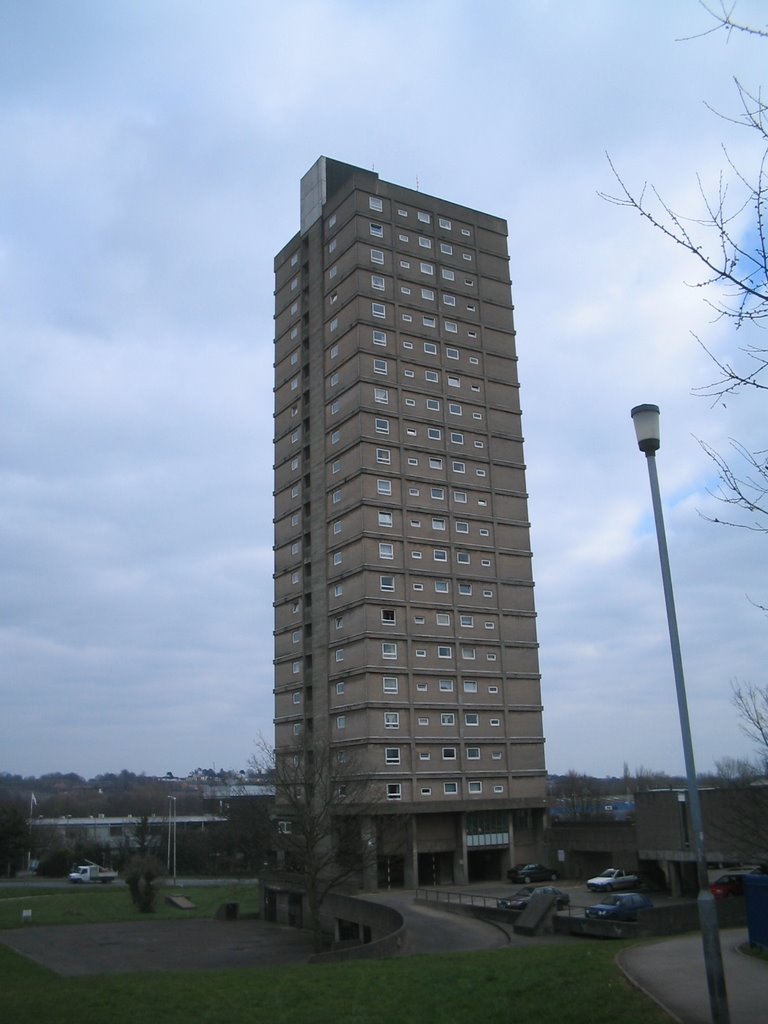
It is therefore not as simple as being pro or anti the 'modernist' vision, each example must be taken first on its own merits - and subsequent to this, we might draw more general conclusions. Do the 1930s skyscraper and the 1960s tower block have less in common or more in common than we first imagine? Can the obvious faults of an unsuccesful realisation provide us with an insight into unseen failings in apparently successful realisations - and vice versa? Can we learn from our mistakes?

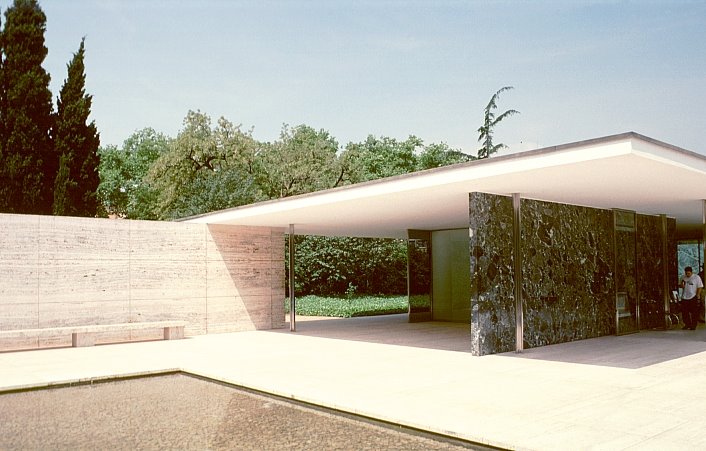
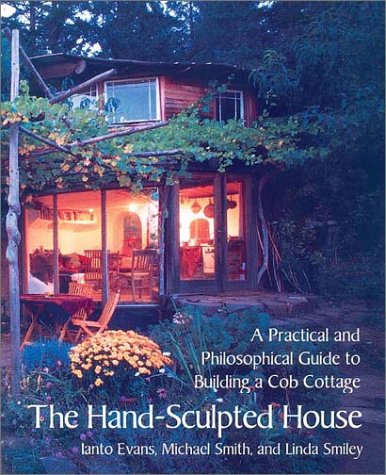
While part of me is caught up in the shiny surfaced sci-fi dream of the skyscraper, the cool lines glass, concrete and steel of empty cubes in minimal houses and apartments – another part is close to the earth, wrapped in a fantasy of organic architecture blending into the landscape, curvilinear and irregular natural materials. Is this the age old dichotomy - town & country, urban vs rural, nature versus culture, Narziss und Goldmund - is it anything to do with youth versus age, or are these too false distinctions? Why do the 'clean' lines of modernist architecture so often seem to require materials which are 'dirty' - polluting (cement/concrete), and environmentally destructive (all the quarried marbles etc.)? How futuristic is a building style that not only has no future, but may be partly responsible for destroying the future?


I really don’t know enough about the New Urbanist movement to make a decent comment on it. I’ve read some of what Kunstler has said about it, heard interviews with Richard Register – and it sounds like there are great ideas in there. But always at my back of my mind is the fear of how the best ideas can be debased. Just as the grand visions of modernism were too often transformed into cheap imitations that both failed to realise the modernist ambition at their root and were significantly worse than what they replaced. When I read or hear about the New Urbanist vision, two examples come to mind that seem to bear much resemblance to what is being talked about, and which I find personally distasteful. The first is where I grew up, and where I find myself residing again, South Woodham Ferrers in the county of Essex in the South East of the UK. This village become town which trebled in size while I was at school was extensively remodelled over that time to move from being merely a commuter dormitory town to somewhere with genuine community. This project (“South Woodham Ferrers – the Place to Be” - apparently) involved building an entirely new town centre from scratch – with town square, faux-medieval pedestrian shopping alleys, church, school, library, supermarket (complete with fake dovecote roof), pub (a new build made to appear to be an agricultural building converted into a pub – with old ploughs etc on the wall for “authenticity”) and later a bandstand in the town square. It was an abject failure, few shops manage to last very long, the land is owned by the superstore (Asda/WalMart) who control the rents and can thus easily destroy any competition, the civic space is largely un-used – except by bored youth, and even their recuperation of the space for graffiti, skateboarding, casual drug use, public drunkenness and fighting has been broken by the introduction of ominous CCTV mounted on gargantuan poles. The paved streets and squares are in disrepair.

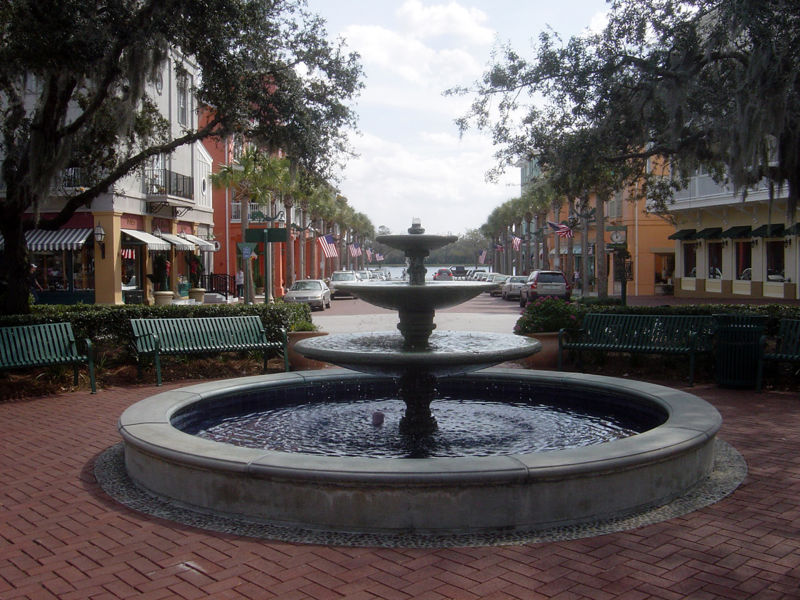
More successful on its own terms, but perhaps even more monitored is the second example – Celebration, Florida, the famed town built by the Walt Disney corporation – not as a theme park, but as a safe, pleasant place for middle class white people to live in a fantasy of the world before rampant capitalism destroyed true communities. This doesn't so much seem to be part of some cohesive vision of a sustainable future for our cities, and a way of rebuilding true communities - as much as a way for the privileged to externalise all the products of the existence they live which they don't like and purchase 'community' as just another commodity.


IMAGES: Chrysler Building in New York, USA (William Van Alen), Tudor Road Tower Block in Cwmbran, Wales, UK (unknown), Barcelona Pavilion in Barcelona, Spain (Mies Van Der Rohe), Cover of 'The Hand-Sculpted House' by Ianto Evans, Town Square: South Woodham Ferrers, Essex, UK, Town Square: Celebration, Florida, USA.

Wednesday, August 02, 2006

I-man satta at the mountain top Watching Babylon burning red hot, red hot


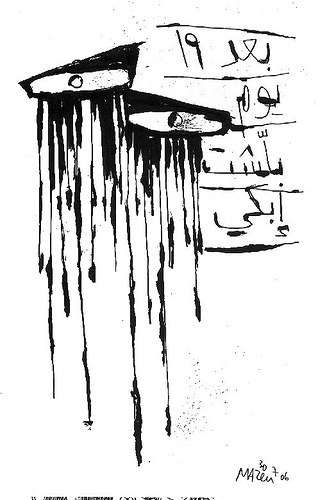
One night a feast was held in the palace, and there came a man and prostrated himself before the prince, and all the feasters looked upon him; and they saw that one of his eyes was out and that the empty socket bled. And the prince inquired of him, “What has befallen you?” And the man replied, “O prince, I am by profession a thief, and this night, because there was no moon, I went to rob the money-changer's shop, and as I climbed in through the window I made a mistake and entered the weaver's shop, and in the dark I ran into the weaver's loom and my eye was plucked out. And now, O prince, I ask for justice upon the weaver.” Then the prince sent for the weaver and he came, and it was decreed that one of his eyes should be plucked out. “O prince,” said the weaver, “the decree is just. It is right that one of my eyes be taken. And yet, alas! both are necessary to me in order that I may see the two sides of the cloth that I weave. But I have a neighbour, a cobbler, who has also two eyes, and in his trade both eyes are not necessary.” Then the prince sent for the cobbler. And he came. And they took out one of the cobbler's two eyes. And justice was satisfied.

“War” from The Madman; His Parables and Poems (A.A. Knopf, 1918) by Kahlil Gibran.


Without comment or critique, here are words and image from two Lebanese artists in these dangerous times. This post is mirrored at Rubedo.


IMAGE: after 19 says i started to cry (2006) by Mazen Kerbaj taken from his Kerblog entry for Sunday July 30th 2006.

Tuesday, May 30, 2006

Carbon Neutrality


Given where we're at with concentrations of CO2 in the atmosphere, I'm not sure this is an issue any of us can afford to be neutral about anymore. Perhaps we should try and make our lives carbon negative, and heal the world (& to continue with Wacko Jacko a while "make it a better place, for you and for me and the entire human race" - which is kind of anthropocentric but what the hey - I can't personally stand most of the man's music, but maybe this message does affect change somewhere in the world).

There is a lot of coverage of environmental issues on UK TV right now, with BBC's Climate Chaos strand in full flow, and last night More4 broadcast an interview with Al Gore at the Hay Literary Festival about global climate change. Unfortunately, I think I overdid it on the horlicks and couldn't make it to the end of the Gore programme (and frankly I guess only the converted would have tuned into something broadcast from 22.40 to 23.45 on a digital channel) but it seemed pretty good, and you did kind of want him to stand again in 2008, and win, and actually bring the USA around.

I hope that all this TV output will increase the number of converts who realise that action is necessary, increase the number of the 'heroic few' who are already acting - changing their own lives, putting pressure on the powers that be to change.

What I am really hoping doesn't happen is that the attention and energy stirred by this media activity is directed into 'green consumerism' or what David Holmgren calls the "Green-Tech stability" route.

I've long had a hang up about the whole idea of carbon credits which I've not been able to accurately articulate - so I was pleased to see the piece Carbon Offsets are a Fraud by Claire Fauset & Merrick, which says all the things I wanted to say and more.

These carbon offsets are popular with your REMs and Coldplays, and Joe Strummer was instrumental in it really taking off, and they'e played a major part in giving respectability to the whole idea. I have a fear that the right on rock musician clique that are engaged with trying to make the world a better place, have been captured by the proximity they can now obtain to politically powerful figures and so do not use their influence for radical enough ends - radical but necessary ends. I know that it is very easy to dis Bono and his ilk on this score (John Pilger and Charlie Brooker have both done it with some style) and I give them credit for their heart action. But we need a rebirth of Orpheus, something I elaborate more on over at Rubedo which is a very different kind of Red.

Friday, May 26, 2006

Rubedo


Yourmindfire is one of the contributors to Rubedo a new arts and cultural site.

Influenced by the alchemical concept of rubedo, the site brings together contributors from the worlds of poetry, music, film, astrology, psychosynthesis and other therapeutic disciplines.

The site currently features "What Red is Not" a meditation on the theme of rubedo and contemporary violence by the eminent English evolutionary astrologer Mark Jones, author of the seminal work "The Nature of the Pluto in Virgo Generation".

Sunday, May 14, 2006

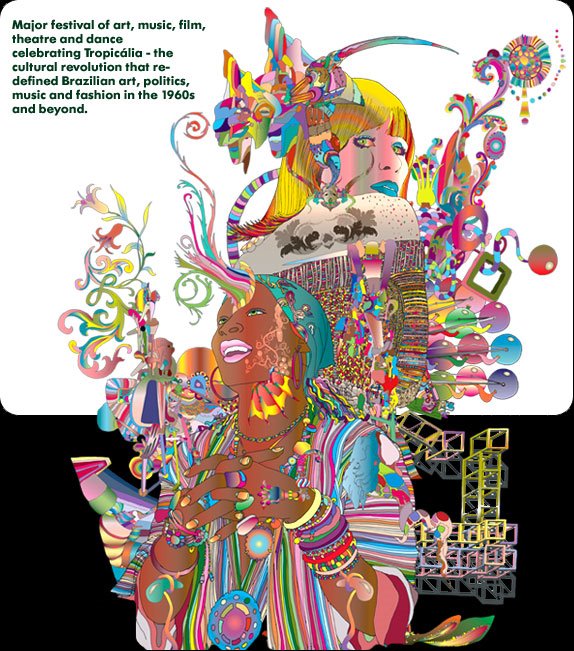
Tropicália


Yesterday I at last got around to the Barbican for the exhibition Tropicália: A Revolution in Brazilian Culture. It finishes May 21st so time was running out for me (and you if you fancy going).

My interest in Tropicália goes back to about 1997 when my wider explorations of psychedelia were increasingly going global and I heard the first hints that there was a Brazilian psych scene. This subsequently crystallized into 2 band names as avenues of further pursuit – The Mutants and Caetano Velaso – it would be many more months before The Mutants reverted to their original language moniker Os Mutantes, and I realised that Caetano Velaso was a man not a band. Getting any records was another issue, eventually in the World Music section of Tower Records, Piccadilly Circus I hit paydirt with the Os Mutantes album Mutantes E Seus Cometas No Pais Do Baurets (this was of course in a more primitive internet age). The cover looked promising and I was excited to get the thing home. But I thought the first track was terrible and I felt my heart sink in that way which is all too familiar to the brave record buyer who strikes out into unknown territory. After that track however it picked up and I loved it and introduced it to my friends with all the attendant thrill of a new discovery.

Keith knew a Brazilian guy called Joao and hit him up for some Brazilian tunes. Joao was pretty dismissive of Os Mutantes and various other names I’d passed through Keith – bad seventies rock was I think his interpretation of these artists, “like Phil Collins” may also have been mentioned. Still a pretty good comp tape of MPB (Musica Popular Brasileira) stuff ended up coming my way – and had to satisfy me for now. In fact that MPB tape got me through a cold winter working in the vaults of the Imperial War Museum Film and Video Archive.

As time passed by I eventually hit my other targets – the Velaso albums, Gilberto Gil, Gal Costa, more Mutantes, Tom Ze (still after that Nara Leao album mind). I came to realise the genius of Rogerio Duprat (and kudos to el/Cherry Red for re-releasing A Banda Tropicálista do Duprat). I discovered that this music was the audio wing of a Brazilian pop art movement, Tropicália – WOW I thought, how groovy! Especially when I discovered it connected up with revolutionary politics, youth movements, artists in London exile etc. etc.

So, when I found out that the Barbican was going to host an exhibition of this stuff I was thrilled. But, BOY – what a let down! For a start there really wasn’t that much to see – the gallery felt kind of empty. And what was there just didn’t seem to amount to much. It was largely ‘conceptual art’ – which I actually don’t have a problem with (all art is conceptual art, the idea that pretty pictures are good art is a concept – anyway I digress) but I think that conceptual art only really works when in presented in an engaging context. I tend to think of conceptual art like Magick, it’s about altering reality through an alteration in consciousness. For this to function requires, I believe (and to borrow from Tim Leary), an appropriate attention to ‘set and setting’. Without that the spell won’t work, things wont change and everyone goes home disappointed.

I mean the first element of this you face as a problem in the gallery context is the admission charge. Before you’ve experienced a thing, a powerful message is being placed in your mind – you are moving into a space where access is determined by the action of a financial transaction. Therefore it is limited to those who can afford it and choose to use their cash in this way. An expectation of return on one’s investment is fostered, a ‘show me’ attitude – we are placed passively as audience. We choose to use our cash in this way because wee are cultured people, we will now spend a period of time in the gallery commensurate with our expenditure (oh, 8 quid by the way, best part of a tenner in other words. Each). Now all this blathering is just to indicate that immediately I don’t think that we’re being presented with the best ‘set and setting’ for our experience on the other side of the admissions desk. I’ve always buzzed much more off gallery spaces like the Whitechapel (1) or Serpentine where you can wander freely straight into the temple.

I know that there are costs associated with doing anything that someone has to pay – but given that, shouldn’t we incorporate the terms of entry into the artwork itself – be open about the process already occurring. Perhaps entry should be afforded in Brazilian Reais only, with a bureau de change located elsewhere in the building – or entry could only be afforded by singing E Proibido Proibir as one passes over payment – or entry could require placing 4 £2 coins into a Tropicálismo slot machine/one art bandit (Oticica’s phrase “Be an outlaw, be a hero” springs to mind) and everyone wins and receives their entry ticket – or… Well you get the general idea.

Putting aside the whole paying for entry issue (and I did anyway, I just wandered in and no one stopped me), the whole set and setting thing inside wasn’t right either. There was no Magick, none of that pagan energy this kind of art demands – instead it’s just your bog standard white cube approach, like some square modernist chapel or summat. Some of the art was ‘interactive’ - in a wonderfully perverse set up – the ‘original art’ was in cases protected from us, while reproductions illustrating the concept were available to handle and engage with. These concepts appeared to have artefacts chaining them to the past, the weight of a former moment preventing them from being free, from truly entering the now – failed invocations.

The best stuff was: the album covers (and why wasn’t there more Rogério Duarte in the exhibition?); the video of Tropicália musicians in their prime (although the projected stuff looked like second generation vhs taped off-air and the sound was shit – didn’t anyone think that being able to hear the music might be important? – and why wasn’t the whole gallery filled with the pounding sounds of Tropicália?); and the women’s dresses, but there was only about six of them.

So buy the albums, listen to the music and dream up your own sixties pop art vision of Sao Paulo and Rio – it isn’t here. I looked.


(1) I’m aware that this exhibition is largely a reconstruction of Hélio Oticica’s 1967 exhibition at the Whitechapel – but I can’t really comment on that – different ‘set & setting’ – different experience.