Showing posts with label Television. Show all posts

Thursday, February 01, 2007

Weary of Time


Last Sunday the Renoir Cinema had a screening of “Ah! Sunflower” a 1967 documentary on Allen Ginsberg in London originally shot for WDR Television in Germany (now available on DVD from The Picture Press). The screening was introduced and later discussed by the novelist psychogeographer Iain Sinclair who had participated in the films production. The programme also included some short films, loosely gathered under the sobriquet “Beat London”.

In the introduction Sinclair read from Kodak Mantra Diaries, an account of the period which formed his first prose work (recently republished by Beat Scene magazine). Forty years old, some of Ginsberg’s words at the conference The Dialectics of Liberation sliced through the intervening period. Prescience or a further record of how long we have had knowledge and not action?

We can leave the planet
We can destroy the planet
We’ve never had history with those possibilities
We’ve had little wars in Asia
Or wars between America & Europe
But we never had a whole planet that could blow itself up
Or could destroy itself WITHOUT even blowing itself up
By destroying its forests
& changing its weather
& making carbon dioxide all over
Raising the temperature of the earth
Melting the polar ice cap
Causing a flood again


Friday, January 19, 2007

Call Me A Kaafir


The mother and father are your attachment to beliefs and blood ties and desires and comforting habits. Don't listen to them! They seem to protect, but they imprison. They are your worst enemies. They make you afraid of living in emptiness.”
The Essential Rumi, translations by Coleman Barks with John Moyne (Harper, San Francisco, 1997)


I do not believe in Belief. But this is an Age of Faith, and there are so many militant creeds that, in self-defence, one has to formulate a creed of one's own. Tolerance, good temper and sympathy are no longer enough in a world which is rent by religious and racial persecution, in a world where ignorance rules, and Science, who ought to have ruled, plays the subservient pimp. Tolerance, good temper and sympathy - they are what matter really, and if the human race is not to collapse they must come to the front before long. But for the moment they are not enough, their action is no stronger than a flower, battered beneath a military jackboot. They want stiffening, even if the process coarsens them. Faith, to my mind, is a stiffening process, a sort of mental starch, which ought to be applied as sparingly as possible. I dislike the stuff. I do not believe in it, for its own sake, at all. Herein I probably differ from most people, who believe in Belief, and are only sorry they cannot swallow even more than they do. My law-givers are Erasmus and Montaigne, not Moses and St Paul. My temple stands not upon Mount Moriah but in that Elysian Field where even the immoral are admitted. My motto is: "Lord, I disbelieve - help thou my unbelief."
E.M Forster “What I Believe” in Two Cheers for Democracy (1951)


Everywhere these days I seem to get into conversations about religion, about faith, about belief. As an adolescent I chose a vigorous atheism, a faith in science, in an enlightened secular society. I wanted to throw off a cultural attachment to unquestioning belief, an inheritance in which the past is our parent. But it didn’t really seem a difficult choice, I felt that the world was sloughing off false beliefs and moving toward a reasoned future, logic would eventually eradicate systemic flaws like monopoly capitalism, nuclear weapons etc etc. Since then I have mixed with friends who have traversed worlds of spirituality and mysticism – I’ve remained a tough nut to crack, but I have gained more respect, tolerance and open mindedness about the spiritual path. Not for religion mind, not for the religio – the obligation, the bond, the submission.

And now a debate I thought was over is all around me, fundamentalism in many forms manifesting in the world – Western Imperialist, Right wing Christianity, Zionism, Wahhabism. All of it to my mind - fascist.

That ‘spiritual’ belief can lead people towards violence, hatred, oppression is so amazingly depressing it’s difficult to know how to react to it. In me it evokes that adolescent spirit which determined to throw off unthinking for intelligence, for inquiry. It stiffens me as Forster says, it makes me say: "I am a Kaafir" – an unbeliever.

A recent television documentary - Dispatches – Undercover Mosque (Channel 4, 15th January 2007) [widely available on YouTube] revealed some of the hate speak being traded in radical mosques – homophobia, misogyny, xenophobia, intolerance. In conversation last night a friend and I despaired at this version of Islam, wished that other followers of the faith were more visible. Perhaps it is too easy to say “what about the Sufis?”, but isn’t it also too easy to concentrate on the purveyors of hate?

Those who trade in hate cover their weakness in many faiths, ideologies, politics – I have no wish to isolate radical Islamists.

I believe in a perennial wisdom that is in all faiths and yet is also felt by the faithless.

I believe in LOVE.


Like This

If anyone asks you
how the perfect satisfaction
of all our sexual wanting
will look, lift your face
and say,
Like this.

When someone mentions the gracefulness
of the nightsky, climb up on the roof
and dance and say,
Like this?

If anyone wants to know what "spirit" is,
or what "God's fragrance" means,
lean your head toward him or her.
Keep your face there close.
Like this.

When someone quotes the old poetic image
about clouds gradually uncovering the moon,
slowly loosen knot by knot the strings
of your robe.
Like this?

If anyone wonders how Jesus raised the dead,
don't try to explain the miracle.
Kiss me on the lips.
Like this. Like this.

When someone asks what it means
to "die for love," point
here.

If someone asks how tall I am, frown
and measure with your fingers the space
between the creases on your forehead.
This tall.

The soul sometimes leaves the body, then returns.
When someone doesn't believe that,
walk back into my house.
Like this.

When lovers moan,
they're telling our story.
Like this.

I am a sky where spirits live.
Stare into this deepening blue,
while the breeze says a secret.
Like this.

When someone asks what there is to do,
light the candle in his hand.
Like this.

How did Joseph's scent come to Jacob?
Huuuu.

How did Jacob's sight return?
Huuuuu.

A little wind cleans the eyes.
Like this.

When Shams comes back from Tabriz,
he'll put just his head around the edge
of the door to surprise us.
Like this.

[Rumi, Translated By Coleman Barks]

Monday, June 05, 2006

If... the Oil Runs Out


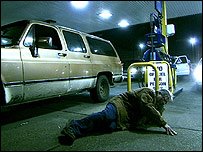
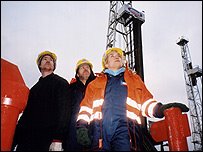
If… the Oil Runs Out was the ‘peak oil’ programme in the BBC’s Climate Chaos strand. A largely unsuccessful attempt at bringing the issue into UK public consciousness.

As with the Attenborough documentary I wrote about previously scheduling was an issue here (23.20-00.20 Tuesday night, BBC2) you had to be pretty much a self selecting viewer to catch the programme – i.e. you are probably a viewer who is informed and interested in the subject (in which case, like me, you probably hoped that the programme would be more focussed on appealing to such viewers). There seems little likelihood that that this programme attracted the kind of random casual viewer who could usefully be apprised of the concept of peak oil and benefit from learning more about it.

A second factor working against this programme communicating the issue of peak oil to a wider audience was its incorporation in the ‘If…’ format. For those of you who haven’t seen one of these before, the basic deal is: ‘If…’ was a series of shows looking at what might happen “if” various different disastrous things happened, such as ‘If… a big fuck off asteroid hits the Earth’ or ‘If… a shitting big wave strikes’- you get the idea. All these programmes were presented in a drama-doc style, inter-cutting actual factual interviews with a dramatised presentation of the proposed outcomes of the particular ‘if’ examined. It has to be said that this is not a wildly successful format, especially in the case of a situation like the decline of a finite resource where ‘when’ rather than ‘if’ seems a more appropriate proposition (The programme also did not particularly address the concept of peak differing from the titled “runs out”). The ‘If…’ format is tainted with a simplistic, populist bad science reputation that ill serves an issue as important as the peaking of oil.

The approach of the format creates the third factor frustrating utility in the programme. The drama-doc style was both cloying and ineffective. From the UK perspective it was also frustrating that it took the form of some spurious transatlantic storyline that seemed designed solely to make it USA saleable (much as Brit movies feature a token yank in some attempt at US box office success). The programme was co-funded by Discovery, so I guess that explains some of this – but doesn’t the UK audience deserve (if they have to have drama-doc) dramatisation of what might happen in the UK, instead we had to watch an American couple deal with the situation in the USA.

Reviews of the programme give some indication of how successful it was in communicating the issue of peak oil.

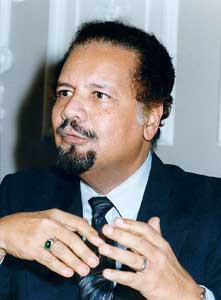
1)The Daily Mail’s Peter Preston gave a schizophrenic response in ‘Are We Really Over a Barrel?’ (Wednesday May 31st, p.49) where he spends a few paragraphs disparaging the “puritans” of the green movement and the “Kyoto fanatics”, then takes issue with the whole idea that we’re in a difficult position energywise, before getting into a good slagging of the programme itself – “a cack-handed attempt to produce a drama out of the oil crisis”. In the middle of all this he finds time to praise Sheikh Yamani and quote his pretty scary vision of the future without further comment. His review ends with “So down with the Cassandras, I say. I’m off for a drive around the block”. It seems that public attitudes may still have a way to go. Does anybody remember these days, that Cassandra was right but ignored? It’s all painfully poetic.

2)The Guardian guide featured the programme in its ‘Watch This’ sidebar, but called it an “annoying drama-documentary” and, like me, thinks that “the subject doesn’t benefit from being dressed up as a soap opera”. It also finds fault with the programmes research stating “one caption informs us that “all the world’s biggest oil reserves are in the Middle East” – actually, the second-largest oil reserves on Earth are beneath Canada’. I’d like to know what expert research Andrew Mueller put into the issue for his review. The idea that Canada has large ‘oil’ reserves is a questionable one, given that they are not in liquid form but locked in bitumen, an issue the Guardian itself raised in 'The next big thing or a risky gamble: Shell looks to turn sand into oil' (June 2nd 2006). This little aside is yet more evidence of how much we need a proper investigative, scientific programme on this issue.

3)I will leave you by quoting in full the review of the programme I received direct from Keith Hackwood – demonstrating his typically acute analysis:

"did you watch that bbc 'if' thing the other night? what a waste of space that was (apart from seeing sandra dickinson looking like my nan) - fatuous 'drama' bollocks, why have Matt Simmons on and then not use him - not have any of his punchy soundbites? the whole thing was just an edited meek drivel of weak idea-less drip drip, extremely conservative in every way (the figures they used, the implications they side-stepped - like violence and collapse of social order, like agricultural despair, for fuck's sake - even after the trucker got laid off and the transport network seized up in this joke programme there were people still shopping at wal-mart! It made me angry and disappointed - a waste of my licence fee on a shitty treatment of a real issue that was somehow left dangling like a bad cracker joke with no punchline - frankly, pathetic."

Friday, June 02, 2006

If Attenborough Speaks Will You Listen?

Last night BBC1 showed part two of David Attenborough's programme on global climate change Are We Changing Planet Earth?/Can We Save Planet Earth?. Primetime telly on a mainstream channel fronted by a widely loved and respected broadcaster telling us this is a "planetary emergency".

It's hard to think of what else you could do to try and convince people of the seriousness of the issue. Until the President of the United States, or a body like the UN or EU issues a widely supported statement saying we need to change our way of life to avoid catastrophe - this is surely as an effective a message as can be put out. Framed within the rest of the BBC's Climate Chaos strand, I think that this is likely to be the most public assault on UK consciousness regarding this issue we'll see until disasters start hitting.

I have to say though that I was a little disconcerted that we ended up getting a section wandering around an average home with an expert suggesting we turn the thermostat down, don't put our tv on standby, use eco light bulbs and only boil as much water as we're going to use. Man, if we're still stuck at the stage of cajoling people at this level you really wonder if anything is ever going to change. The suggested plans for larger scale reductions in carbon emissions seemed a bit specious and ill supported. Nuclear was again presented as a carbon free energy source, typically skirting over the issue of CO2 emissions during the whole nuclear cycle (similarly the emissions, and chemicals used in the production of solar pv cells and wind turbines were elided). Carbon sequestration was also featured without any detailed analysis. Don't we deserve a better investigation than this?

The programme suffered from mixed ambitions, combining an attempt to communicate hard science and the reality of the global situation with an aim of reaching a wide audience and convincing them to turn their TV off at night.

Within the Climate Chaos strand one would have hoped there was room for both ambitions to be realised without them conflicting in one programme. This was a valuable programme, but it could have had greater value - and we don't have time to muck around now.