Showing posts with label Environment. Show all posts

Friday, March 07, 2008

The Gift

The Gift

The gift
And the feeling behind the gift
The character of the giving
The process and action
Which presented this gift.

A dance around the question
Of selfishness
And selflessness
An attempt to act
In a way which is ‘Right’

To offer each action up
As some recompense
Or sacrifice
For my no doubt myriad other sins?
Failures to take it
To stand where I am
Speak what I think
Not lie
Nor circumvent
Look for easy paths
Short cuts
That avoid a necessary journey.

And in this search for ‘Rightness’
I sense a ghost
Of lost romance
Broken eros
Trying to reform as agape
Afraid of eros
Afraid of breaking.
In a woman
In Love
There was a bridge
out of an isolated sense of self
Love is the Magick
But now where does the bridge lead?

A kiss in the morning can be more dramatic than a drama by Mr. Fancypants

This assignment has led me to reflect on my creativity in a number of ways and also to consider the role that an artistic attitude and creative engagement might play in a human ecology perspective. I will explore this through personal narrative, thoughts around my poem The Gift (which itself reflects on creativity) and interaction with the texts of others.

Over the years I have engaged with creativity in a number of ways, and I remember how as a child I enjoyed the play of art making. Around the time of adolescence my relationship moved from being primarily a producer of creative activity to becoming a receiver and commentator. I studied literature for three years at university and later studied cinema for a year. In between I worked in the art school’s library surrounded by volumes of artistic expression and by creative artists themselves – painters, sculptors, weavers, and performance artists, artists exploring time, space and materials in a thousand different ways.

I had (have) friends who were (are) poets, painters, musicians and my brother makes his living designing clothes. I read and read, I have visited art galleries around the world, worked in cinema archives, maniacally bought and consumed recorded music, seen music performed live innumerable times. Through out much of this time I attended little to my own creativity. In many ways I was like the ‘shadow artist’ described in The Artist’s Way (Cameron, 1995) “Shadow artists often choose shadow careers-those close to the desired art, even parallel to it, but not the art itself”(p.27).

But I was not completely cut off from my own creativity – I wrote poetry, furtively, not for general consumption; and I scribbled, doodled, sketched on hundreds of pieces of scrap paper. I took photographs; I took a class in photography.

As I grew older, I became more confident in expressing myself in these ways – though that expression remained largely without an audience, and while I didn’t hide away what I did neither did I make any effort to share my output. I remained caught in a problematic conception of art and creativity. The need for me create and the value I felt in creativity was tempered by a perceived sense of the low value of my creative output.

I recently encountered the work of psychologist Guggenbühl-Craig on creativity and this formalised a lot of my only partly consciously thoughts. Guggenbühl-Craig divides the concept of creativity into three distinct manifestations, which he describes as: personal creativity, collective creativity and transcendent creativity.

He is dismissive of the first kind, writing that (Guggenbühl-Craig, 1995) “we should not refer to personal creativity as creativity at all”; we should in fact refer to it as “self-development, self-expression or something similar” (p.7). By collective creativity he meant the work of the advertising and fashion industries that attempt to follow and shape the zeitgeist. Finally, in transcendent creativity he identifies what we conventionally consider ‘high art’ – the work of ‘geniuses’ Shakespeare, Bach, Michelangelo etc.

For several years I had been dismissing my creativity as not really “creativity at all”, and thus of little value. I was in fact devaluing my self and my actions, looking back on this now it is easy to see both that this mirrored my sense of political agency and that many others seemed to be trapped by this same dynamic. In placing a low value on what I could personally achieve, and deferring value to others I was handing away my own power. I felt so dwarfed by the attempt to reach that transcendent creativity, the only art in which I was socialized to find value that I tended to not act at all. This is what Cameron (1995) describes as debilitating perfectionism “Part of the game here is lining up the masters and measuring our baby steps against their perfected craft” (p.121).

This inertia, the sense of being daunted by the scale of the task immediately resonates for me with my own and others’ feelings about global ecological problems and issues of social justice. I wondered if there might be support from artists and radical politics that might suggest routes out of this way of thinking.

Audre Lorde (1984) in a perfect challenge to Guggenbühl-Craig’s value division of creativity writes “yes, there is a hierarchy. There is a difference between painting a back fence and writing a poem, but only one of quantity. And there is, for me, no difference-between writing a good poem and moving into sunlight against the body of a woman I love” (p.58).

I found that the surrealists spoke of a ‘communism of genius’, and that the situationists made a revolutionary call for an ‘art made by all or not at all’ (Debord, 1957). Similar sentiments to Lorde’s were evident in the Fluxus movement (Higgins, 1984) “They said: "Hey! - coffee cups can be more beautiful than fancy sculptures. A kiss in the morning can be more dramatic than a drama by Mr. Fancypants "” (p.87).

The therapist Thomas Moore (1994) offered another take suggesting the association of creativity with “lofty fantasises of exceptional achievement’” (p.198) is a juvenile romanticization of the creative act. He suggests we bring our idea of creativity down to earth and realise the role of creativity in our everyday lives. He proposes that human creativity is “a participation in the act of God creating the cosmos”, but this lofty claim is rooted in quotidian practice “As we do our daily work, make our homes and marriages, raise our children, and fabricate a culture, we are all being creative” (p.199).

The artist Joseph Beuys formulated an idea of artistic practice he called ‘Social Sculpture’, in which all humans are seen as ‘artists’ responsible for the shaping of a democratic and sustainable social order. He wrote that we are all, everyday working with “invisible materials”:

Thinking Forms - how we mould our thoughts or

Spoken Forms - how we shape our thoughts into words or

SOCIAL SCULPTURE - how we mould and shape the world in which we live:
Sculpture as an evolutionary process; everyone an artist.
(Harlan, 2004)(p.9).

These ideas are all rich to me, fertile with possibilities of how I might live life and how creative practice might play a role in social engagement.


To thine own self be true

As I was considering the creative element of this assignment I was reading Lewis Hyde’s The Gift: How the Creative Spirit Transforms the World. In this book Hyde (2006) makes the case that “the art that matters to us – which moves the heart or revives the soul, or delights the senses, or offers courage for living, however we choose to describe the experience – that work is received by us as a gift is received” (p.xiv). In considering the transactions of art as gift exchanges he writes of other gift economies – a modern one referred to by sociologists is blood donation (Titmuss, 1971).

While I pondered creativity and what this gift quality might mean, I also thought on the importance of these convivial actions that form a sense of world. So I made an appointment and a few weeks ago I donated blood. The session took place in Conway Hall a “hub for free speech and progressive thought” (Anon. 2007).

I took a place on a bed and a phlebotomist examined my left arm. Unable to find a vein, she said she would need to try my other arm and had me turn about head to tail. She quickly found a vein on my right arm but it was close to the surface, it would likely bruise she said, but this might elicit sympathy for me. Calling a colleague over, they considered another vein – one that was deeper, less accessible, reaching which might cause more discomfort.

They successfully punctured it and left me reclining, right hand gripping and releasing to act as a pump – hand become another heart at the extremity of my arm. Now, as I had been turned about, I faced the stage of the main hall and I found myself staring directly at a legend painted upon the proscenium arch:

“TO THINE OWN SELF BE TRUE”

It was the only thing available to read for the 10 minutes of the session, and filled my attention. I remembered it being from Shakespeare’s Hamlet, Polonius’s advice to Laertes. In this period of contemplation two words stood out from the others: “SELF” and “TRUE”. The Human Ecology course has led me to consider anew questions of identity, and my recent reading and thoughts have constellated about ideas of the transpersonal. These ideas have challenged me to think about where my sense of self begins and ends, to consider an expanded sense of self. Now this line also challenged me, forcing me to ask: what I considered “self”, what constituted my “own self” and what was/is “true” to that self? How could I be true to an expanded sense of self? In any creative expression how could I speak truly?

In The Artist’s Way, Cameron (1995) writes of synchronicity, the attractive force of action in the world, that when one acts, one draws towards oneself what one needs (pp.62-67). Although dubious about this idea I was struck in the following week to find the line “to thine own self be true” again: in Cameron (1995) (p.80) and then in Carol Gilligan (1982) (p.135). This question of a true self seemed determined to be confronted.

In not going for the shallow vein, the phlebotomist’s decision to first choose my right arm, my writing arm and then to go for the deeper vein that would be more difficult, possibly painful seemed like a message to deepen my own enquiries. So in writing for this assignment I felt the need to explore in poetry what the creative act might mean to me, how it might function in my life, and what it might serve.

I was aware that my past writing had often been born of emotional turmoil, out of the fracturing of romantic love. Applying more thought to the issue I noticed how questions of love and creativity had become entwined in my imagination.

I realised that, for me, both art and love were a ‘bridge’, a pathway out of a purely individual conception of self toward a communion with other – be that a lover or a more abstracted sense of ‘audience’. When this link had been the bridge of romantic love – the destination had been one other person – but in making a leap from oneself a connection to everything outside the individual self was made possible. The creative act was in itself an act of love because it was about the formation of relationship.

I wondered in The Gift whether perhaps a bridge toward community and a “more-than-human”(Abram, 1997)(p.22) world would require a different kind of love – not eros (romantic love) not even what the ancient Greeks called philia (familial, brotherly love) but something of what Christians understand by the term agape (unconditional ‘divine’ love). I discovered that Lorde (1984) also wrote of this bridging quality of love, but without the need to divide up love she simply expanded the conception of the erotic. She writes that the spiritual and political are connected and “the bridge which connects them is formed by the erotic - the sensual - those physical, emotional, and psychic expressions of what is deepest and strongest and richest within each of us, being shared: the passions of love, in its deepest meanings” (p.56).

I believe that by engaging with our creativity we participate in forging a better world, that an artistic approach to life might form a cornerstone of activism, I feel inspired by these words of Robert Sardello (1999) “Beauty, which will be here defined as the act of living artistically, is love made visible in the world. Artistic living consists of the ability to display, through our actions and attitudes, the power of soul and spirit in the world” (p.209). Shakespeare’s Hamlet which, indirectly, inspired much of my thinking here, has been seen as a core text of the birth of individualism in humanistic thought – a form of consciousness that encouraged an isolated self perception, a separation of what we consider ‘inside’ and ‘outside’ ourselves (Bloom, 1998)(Johnson, 1991)(Lane, 1996). That powerful line “To thine own self be true” also seems to contain the beginnings of another conception however, that of a truer vision of selfhood. Creative engagement, considered as an act of love, of giving, seems a way that I might find that a truer self.

References

Abram, David (1997) The Spell of the Sensuous. New York, Vintage.
Anon. (2007) A Brief History of Conway Hall [online]. Available from: http://www.conwayhall.org.uk/conwayhallhistory.htm [Accessed 13th February 2008].
Bloom, Harold (1998) Shakespeare: The Invention of the Human. New York NY, Riverhead Books.
Cameron, Julia (1995) The Artist’s Way: A Course in Discovering and Recovering your Creative Self. London, Pan Books.
Debord, Guy (1957) Report on the Construction of Situations In: Ken Knabb (Ed. and Trans.) (2006) Situationist International Anthology. Revised and Expanded edition, Bureau of Public Secrets, 2006.
Gilligan, Carol (1982) In a Different Voice: Psychological Theory and Women’s Development. Cambridge MA, Harvard University Press.
Guggenbühl-Craig, Adolf (1995) From the Wrong Side: A Paradoxical Approach to Psychology. Woodstock CN, Spring.
Harlan, Volker (Ed.) (2004) What is Art?: Conversation with Joseph Beuys. Forest Row, Clairview Books.
Higgins, Dick A Child’s History of Fluxus In: Charles Bernstein et al. (eds) (1984) Horizons: The Poetics and Theory of the Intermedia. Carbondale IL, Southern Illinois University Press.
Hyde, Lewis (2006) The Gift: How the Creative Spirit Transforms the World. Edinburgh, Canongate.
Johnson, Robert A. (1991) Transformations: Understanding the Three Levels of Masculine Consciousness. San Francisco CA, HarperCollins.
Knabb, Ken (Ed. and Trans.) (2006) Situationist International Anthology. Revised and Expanded edition, Bureau of Public Secrets, 2006.
Lane, John (1996) A Snake’s Tail Full of Ants: Art, Ecology and Consciousness. Dartington, Resurgence).
Lorde, Audre Uses of the Erotic: The Erotic as Power In: Audre Lorde (1984) Sister Outsider. Freedom CA, The Crossing Press.
Moore, Thomas (1994) Care of the Soul: A Guide for Cultivating Depth and Sacredness in Everyday Life. New York NY, HarperPerennial.
Sardello, Robert (1999) Freeing the Soul from Fear. New York NY, Riverhead Books.
Titmuss, Richard M. (1971) The Gift Relationship: From Human Blood to Social Policy. London, George Allen & Unwin.

Wednesday, January 09, 2008

Imagine No Possessions


To Have Or To Be

Erich Fromm

Jonathan Cape, Great Britain, 1978

We've Had 100 Years Of Psychotherapy - And The World's Getting Worse

James Hillman & Michael Ventura

HarperCollins, USA, 1992

_______________________________________________________________


As the global situation deteriorates in the face of resource depletion, climate change and ecological destruction it is becoming increasingly apparent that the roots of our problems may not be primarily scientific, political or economic but rather psychological and spiritual. Change toward a sustainable and equitable society will require a paradigm shift in our conception of the world and an expansion in our sense of self if our actions on other levels are to be truly effective. These two books by eminent therapists provide psychological approaches that offer a diagnosis of the global situation, reading back from the symptoms and the “presenting issues” to find the underlying causes and a process that offers a means of healing. To differing degrees they advise how we might think differently so that psychological and spiritual inquiry might be fed back as engaged action into the scientific, political and economic spheres.


Erich Fromm's book is an academically rigorous, referenced work aimed at a wide popular audience, and is written in such a way as to communicate easily. His theme in To Have Or To Be is set out concisely by his title, that humanity faces a choice between two modes of existence: that of having (ownership, possession, domination, an experience of the world as a collection of objects) and that of being (belonging, reciprocity, becoming, a relation to the world as a communion of subjects). Human society has been pursuing the first mode up to the point of our current crises; Fromm considers the second mode to be the necessary base for our salvation from them.


Crucially, however, Fromm also believes that switching modes alone is not enough to produce effective action. Social change results from a transformation in what he calls the ‘social character’, a blending of the individual psychical sphere and the socio-economic structure of which the individual is part. To alter that socio-economic structure we require new social forms ‘that begin to bridge the gap between what is necessary and what is possible’. Sadly the more detail Fromm provides as regards action, the more apparent the historical distance between the period of authorship and the present becomes. The existing socio-economic structures he discusses have already gone thorough a series of changes. While the ‘fake socialism’ of the USSR he decries has fallen with that state, the capitalism he bemoans has proceeded, as he feared, to even greater triumph in dictating the direction of the world. Also, when he espouses the ‘energizing attraction of a new vision’ he states it with the caveat that the chances of a change in the mode of existence of the global population ‘remain slim’. Three decades on from its initial publication I found it difficult not to assume the disempowering stance that those slim chances will have attenuated to extreme emaciation, if not impossibility across the intervening years.


James Hillman and Michael Ventura's book We've Had 100 Years Of Psychotherapy - And The World's Getting Worse plays off the interaction of two voices - the learned sagacity of Hillman and the New Journalism of Ventura. The resulting tone is populist, informal, conversational and determinedly in your face, an instant contrast to the structured prose of Fromm. The statement late in Fromm's book that ‘[p]urely psychological change... has been completely ineffective’ is however at the core of the Hillman/Ventura dialogues. In fact, as their title reveals, their book exhibits anxiety about the solipsism of the current therapeutic mode, of a psychological inquiry that only looks inward not outward at a worsening world. The authors counsel that we have become a little too obsessed, possessed even, by “our” problems. Hillman pointedly notes that ‘[p]ersonal growth doesn't automatically lead to political results’. He also poses a question to Ventura: ‘could analysis have new fantasies of itself, so that the consulting room is a cell in which revolution is prepared?’

Ventura relates an exchange with his son about agency in the world in the face of ‘ecological disaster’ and the authors offer him and us a look at the worst and a challenge in how to act. The purpose of concerned souls, they propose, is found in ‘trying to be a wide-awake human during a Dark Age and keeping alive what you think is beautiful and important’. They suggest these might be ‘ideas, art, knowledge, skills, or just plain old fragile love, how we treat people, how we help people’. This is a call to build resilience in what we cherish, to maintain what is valuable in being human, and to support hope. Hillman and Ventura’s choice to share authorship and to present their ideas in this discursive form provides a literal example of dialogic relating and a conversation I certainly felt we were invited to join.

What both books propose is an expansion of our sense of self, of soul - beyond the skin of the individual to include the flesh of the world, the world soul, anima mundi. This transpersonal sense of self would end divisions, dualisms such as man/nature or world/self and extend our essential concerns across the entire ecosphere. Hillman writes ‘I would rather define self as the interiorization of community’ that is: include within the sense of self that which has previously been considered outside self. This is where the psychological gains a spiritual dimension, as this expanded non-dual conception is akin to the ‘you are that’ of Vedanta or Martin Buber’s call for the boundless relationship of an I-Thou rather than an I-It attitude towards the world. But the authors of both books stress the necessity of turning insights outwards; the psychical and the spiritual must drive action in and with the world. Effecting global change cannot be programmatic, domineering - the problems we face cannot be solved at the same level we were at when we created them. Our solutions must be creative, participatory and dialogic. In facing the challenges ahead it is clear that our heads and hearts must share the task of our hands, we need a praxis bold as love.

Friday, March 02, 2007

Orphic Trinity - Orphic Resonance

Last night I attended the first of the Gaia Foundation’s 2007 evenings, this one with Brian Goodwin, leader of the MSc in Holistic Science at Schumacher college (and thus a close colleague of the previous speaker Stephan Harding’s whose talk I covered here).

As you would expect there were many parallels with Stephan Harding’s talk, and both were based around new publications – in Harding’s case Animate Earth: Science, Intuition and Gaia, in Goodwin’s Nature’s Due: Healing Our Fragmented Culture. Both speakers made the case for holistic versus reductionist science and for a reappraisal and acceptance of animism – the belief that a “soul” or “spirit” existed in every object, even if it was inanimate.

Goodwin asked us to reconsider the stories of science, by telling different stories we find a different path. Following a Jungian, archetypal model Goodwin identified a “new” story that has emerged in our culture, which is actually the re-emergence of an old story – which alters our perceptions on science and opens up through animism a new connection with nature. This story is the myth of the Orphic Trinity – Chaos, Gaia and Eros.

Verily at the first Chaos came to be, but next
wide-bosomed Earth, the ever-sure foundations of all the
deathless ones who hold the peaks of snowy Olympus, and dim
Tartarus in the depth of the wide-pathed Earth, and Eros,
fairest among the deathless gods, who unnerves the limbs and
overcomes the mind and wise counsels of all gods and all men
within them
.”
Hesiod, Theogeny (c.700 BC)

Goodwin posited the era of the 1960’s as the genesis point of this archaic revival, first with the re-emergence of Chaos in the work of mathematician Edward N Lorenz. Lorenz attempting to apply mathematical modelling to meteorological phenomena and weather prediction discovered that apparently small changes in initial conditions produced large changes in the long-term outcome. These variations in initial conditions could be so numerous and so slight that they made accurate prediction of future effects impossible. What he described as Deterministic Nonperiodic Flow has become better known as Chaos and has become an important part of mathematical and scientific enquiry. It would appear, as some anarchists and magickian’s claim: that “chaos never died”.

"Does the Flap of a Butterfly's Wing in Brazil Set Off a Tornado in Texas?"
Edward N. Lorenz, paper delivered to the American Association for the Advancement of Science (1972)


For the mass of practicing scientists... the change did not matter immediately... But they were aware of something called chaos... More and more of them realized that chaos offered a fresh way to proceed with old data... chaos was the end of the reductionist program in science.”
James Gleick, Chaos: Making a New Science (1987).


The second element of this archaic revival was the re-emergence of Gaia in the pioneering earth systems science work of James Lovelock and Lynn Margulis. This work finally gained its crucial nomenclature as a result of a conversation between the neighbours Lovelock and novelist William Golding in 1969.

Most of us sense that the Earth is more than a sphere of rock with a thin layer of air, ocean and life covering the surface. We feel that we belong here as if this planet were indeed our home. Long ago the Greeks, thinking this way, gave to the Earth the name Gaia or, for short, Ge. In those days, science and theology were one and science, although less precise, had soul. As time passed this warm relationship faded and was replaced by the frigidity of the schoolmen. The life sciences, no longer concerned with life, fell to classifying dead things and even to vivisection. Ge was stolen from theology to become no more the root from which the disciplines of geography and geology were named. Now at last there are signs of a change. Science becomes holistic again and rediscovers soul, and theology, moved by ecumenical forces, begins to realise that Gaia is not to be subdivided for academic convenience and that Ge is much more than just a prefix.
James Lovelock, “What is Gaia?

The final element of the trilogy is Eros, the force of love, also known as Eleutherios, "the liberator" and through that shared role connected with Dionysus – god of intoxication, music, peace, the civilizing urge – and thus also connected with Orpheus and the Orphic mysteries (I wrote about some of this previously in The Rebirth of Orpheus over at Rubedo). Goodwin asked the audience “who here lived through the 1960s? Can you recognise anything familiar here in the aspects of this deity?”

THE COURT: "Erotic," did you say?
THE WITNESS: Erotic.
THE COURT: E-R-O-T-I-C?
THE WITNESS: Eros. That means love, your Honor
.”
From the Court Testimony of Timothy Leary at the trial of the Chicago 7 (1970)


Love, love, love.
Love, love, love.
Love, love, love.

There's nothing you can do that can't be done.
Nothing you can sing that can't be sung.
Nothing you can say but you can learn how to play the game.
It's easy
.
Lennon/McCartney, All You Need is Love (1967)


Goodwin indicated that we are still in the process of integrating these archetypal forces into our science and into our culture, with the attractive force of Eros suffering from most neglect.

The discovery of DNA by Rosalind Frankin (Crick, Watson, Wilkins etc.) in 1953, with its beautiful double helix formation began a quest in the biological sciences to decode the organism and gain some total understanding of life. Goodwin quoting Evelyn Fox Keller’s The Century of the Gene presented the case that the completion of the human genome project had, rather than bringing such a total understanding, in fact revealed how large the gap is between genetic information and biological meaning. How the particular structure of organisms develop largely remains a mystery, there is some embodied meaning in the cells which is inaccessible to consciousness. Goodwin posits that the development and organisation of form by cellular DNA occurs through the action of a kind of language – and that particular forms are the stories told in that language.

Thus herbalists may develop the ability to read the story of a plant as manifest by its form and intuit the qualities of that plant. The holistic enquiries of wise women and cunning men from the era before reductionism took hold may have genuinely born a “shamanic knowing” that is not only dismissed by our modern science but is beyond its conception. Goodwin stated that meaning is “immanent” not “transcendent” – when science attempts to de-particularise and abstract, it in fact moves further from rather than close to meaning.

So Goodwin asked, how do we engage with this? How do we go about re-integrating this sense of nature in our science and culture? How do we achieve harmony with our fellow entities? Relating this back to the Gaia Foundation’s work and the influence of theologian Thomas Berry, Goodwin suggested that by beginning to change our conceptions we participate in a greater change in consciousness, that this is part of “engaging in the great work” – the alchemical transformation of ourselves and society – the paradigm shift which might be understood as the Magnum Opus.

Thursday, March 01, 2007

An Inconvenient Truth


Another tip from Keith, the full version of Al Gore's climate change documentary An Inconvenient Truth.

Watch it here by clicking above. Taken from the source on Daily Motion.

(To good to be true (inconveniently) the producers would prefer you not to see this film for free I'm afraid. It's now been taken down)

The official site for the film is here, and features more information including a free downloadable "companion educational guide".


Support the Campaign Against Climate Change.

Thursday, February 22, 2007

Slumming It

"The city is our ark in which we might survive the environmental turmoil of the next century. Genuinely urban cities are the most environmentally efficient form of existing with nature that we possess because they can substitute public luxury for private or household consumption. They can square the circle between environmental sustainability and a decent standard of living. I mean, however big your library is or vast your swimming pool, it'll never be the same as the New York Public Library or a great public pool. No mansion, no San Simeon, will ever be the equivalent of Central Park or Broadway."

Mile Davis interviewed by Tom Engelhardt in “Tomdispatch Interview: Mike Davis, Green Zones and Slum Cities


On Monday evening I went over to RIBA (the Royal Institute of British Architects) to see a talk by Mike Davis, the American cultural historian, political activist, social commentator etc. (you may remember me linking to his piece on Dubai in a post last year). Davis is in London all week doing a series of events on different subjects ranging from the future of the “New Left” to his new book: Buda’s Wagon: A Brief. History of the Car bomb.

The RIBA event was billed in different places as being about “Architecture and Climate Change” or his earlier book Planet of Slums. I was happy to hear about either, and it actually turned out to be about both and about much more. The issue of climate change was neatly folded back on to and revealed in the light of the economic hegemony of neo-liberal globalisation.

Having become pretty disillusioned with “leftist” politics and generally feeling that, while the intellectual analyses and critical techniques of Marxist and Socialist thought were still valuable, close association with these as part of a political programme was an ideological trap that kept us in a dualistic dead end – it was amazingly invigorating to be shaken about a bit by a serious hardcore mind from the Left.

The social and ecological strands met in an examination of the emerging “landscapes of inequality”, where resource depletion and climactic change are already causing the migrations and tensions over migration which many see as an unavoidable part of the global future. Davis focussed on the American South West, especially the US/Mexico borderlands – the area he is most familiar with – but also referred to the analogous spaces of the Mediterranean, and the near Middle East.

I went to the talk imagining that Davis would be outside the energy descent sphere and that I would be taking what he said and doing my own mental associations and analysis to assimilate what I learnt there with what I’m learning from elsewhere. It quickly became apparent that I wouldn’t be required to make the connections alone – “peak oil” and “peak water” rolled off Davis’ tongue with familiarity, he referred to suburbanisation and Kunstler, he could see what was coming.

When it came to the environmental issues, Davis reinforced what I’m increasingly learning: that the necessity for consensus in the IPCC report, and the lead in time on the data it is produced from mean that it reflects a “moderate” view far from the beliefs and predictions of many serious and significant climate analysts, and that new information is already radically reshaping our view of what might be currently occurring. Most significant is the rising body of opinion and data indicating rapid melting of the Greenland and Antarctic ice shelves, concomitant sea level rises, the passing of several significant tipping points, and the possibility that, as Lovelock suggests, the Earth is adjusting to a new hot state – that we could be seeing the end of the Holocene.

After years of it being on my list of “to reads”, Davis’ compelling prose style has finally led to me picking up his “LA book” City of Quartz, which is excellent and I think that pretty much everything else he has written is going to have to follow… One thing I am especially interested in following up on, is encapsulated in the quote at the top of the entry. A lot of my current thoughts are about the possibility of Transition Cities - a scaled up version of the Transition Town idea. My gut feeling was that a city the size of London (let alone one the size of Bombay or Karachi say) could not effectively and sustainably function in a state of energy descent. Recent conversations and other inputs (not least Stewart Brand's "City Planet" lecture at the Long Now Foundation) have encouraged me to re-examine this supposition. I will return to this issue as my ideas develop.

Thursday, February 01, 2007

Weary of Time


Last Sunday the Renoir Cinema had a screening of “Ah! Sunflower” a 1967 documentary on Allen Ginsberg in London originally shot for WDR Television in Germany (now available on DVD from The Picture Press). The screening was introduced and later discussed by the novelist psychogeographer Iain Sinclair who had participated in the films production. The programme also included some short films, loosely gathered under the sobriquet “Beat London”.

In the introduction Sinclair read from Kodak Mantra Diaries, an account of the period which formed his first prose work (recently republished by Beat Scene magazine). Forty years old, some of Ginsberg’s words at the conference The Dialectics of Liberation sliced through the intervening period. Prescience or a further record of how long we have had knowledge and not action?

We can leave the planet
We can destroy the planet
We’ve never had history with those possibilities
We’ve had little wars in Asia
Or wars between America & Europe
But we never had a whole planet that could blow itself up
Or could destroy itself WITHOUT even blowing itself up
By destroying its forests
& changing its weather
& making carbon dioxide all over
Raising the temperature of the earth
Melting the polar ice cap
Causing a flood again


Tuesday, January 09, 2007

It is poverty to decide that a child must die


It is poverty to decide that a child must die so that you may live as you wish.”
Mother Theresa of Calcutta


The “Money” section of Saturday’s Guardian newspaper had a half page article titled “The green revolution: Why wheat is luring the breadwinners” – which detailed how commodity dealers are taking advantage of the increase in global wheat prices.

After making millions from pumping up the price of copper, zinc and other metals to record levels last year, speculators are piling into “soft” commodities such as wheat and corn amid drought warnings and global shortages

Is this what they mean when they say the market will find solutions to the problems of global warming, fossil fuel decline etc.?

At present these increases in price are happily absorbed in the shopping baskets of the West, pence or cents on bread being almost invisible to all but the poorest parts of the American and European populations. The wholesale disengagement of price from value in the west, where discounting, loss leaders, sales, just-in-time delivery, e-commerce, globalised production, packaged products and services etc have confused everybody to the point of not understanding what anything is really worth anymore – have made the poorest parts of society practically blind to price rises in individual products too (Although Monday’s The Scotsman reports that “BREAD prices are set to burst through the £1-a-loaf barrier because of rising worldwide flour prices” seeing this as another burden on the British public already facing energy price rises, and increased mortgage payments due to interest rate rises). Avid readers will remember me touching on this issue last November.

In the Third World though these same price rises of staple foods can be devastating, and where they represent, as here, scarcity – inevitably lead to malnourishment, hunger and famine. If global climate change is responsible for the poor harvests, as it appears to be, then here we are seeing again how the poorest of the world, the wretched of the earth will feel the pain of our folly first.

Much is currently being written about how last years fall back in oil prices, reflected the Third World just being priced out of the market. Countries that cannot afford oil at $50 a barrel or above have just stopped buying - freeing up some supply for those who can, filling the gap between rising demand (in the West, China, India etc.) and static supply.

Climate change, peak oil – the world’s poor are acting as our buffer, but for how long? And what about the resulting effects – events on the Horn of Africa providing a current obvious example. Floods followed by drought in the late 1990s set the desperate stage for the actions that have followed in Somalia. The photograph of the dead child above is from the 1992 famine in Somalia, according to the World Health Organisation currently a quarter of Somali children die before reaching the age of five. Is it any wonder that people turn to extreme action, fundamentalist faiths in the face of this situation? As the USA bombs there, as another front of its “war on terror”, I wonder how many of the children who survive will grow up understanding their actions, understanding the behaviour of the West.

Tuesday, December 19, 2006

Do you want ice with that?


Calculating future sea level rises seems to be an inexact science - there are just far too many variables - this however is not a reason for complacency - quite the opposite, when you cannot be sure of the degree to which an effect will manifest then you have to include the conceivable worse case scenario in your planning.

The online version of the journal Science recently published an article titled ‘A Semi-Empirical Approach to Projecting Future Sea-Level Rise’ by Stefan Rahmstorf of the Potsdam Institute for Climate Impact Research. This article suggests that the sea level rise predictions made by the Intergovernmental Panel on Climate Change (IPCC) in their Third Assessment Report (2001) under-estimate the actual likely increases. Using the initial data produced by the computer models of the IPCC and additional empirical information gained through observation, the researchers for this article found that in 2100 sea levels would be 0.5-1.4m above 1990 levels. This contrasts with the 9-88cm forecast made by the IPCC.

The IPCC issue their Fourth Assessment Report in February 2007 and it will be interesting to see how their predictions may have altered.

Meanwhile, why not check out this site which Keith linked me up to, which allows you to see the effect of varying degrees of sea level rise on the geographical location of your choice. And remember this information does not include storm surges, freak storms, hurricane of tsunami effects!

The animation at the top show the predicted decline in Arctic sea ice courtesy of the US
National Center for Atmospheric Research. The animation below is one of many put together by the National Environment Trust indicating the possible effects of a combined sea level rise and a storm surge on major US cities - this one is everyone's favourite disaster movie target - New York City:


Thursday, December 14, 2006

Together in Electric Dreams

If we accept that we face a future of energy descent, and/or that our current profligate use of energy is contributing to global climate change (and I think we accept both right?) then we must use less energy.

Using less - and ideas of reduction can be unappealing and hard ideas to sell. Most of us, even those of us who accept a need to use less energy would prefer to keep as many of the benefits of modern convenience as we can. Therefore we want to find the most efficient ways of doing things while minimising any increase in the intensity of labour. So, given that we already turn everything off at the wall when we’re not using it, never use standby, have replaced our light bulbs with leds - what else might we do to bring our electricity demand down?

Washing your clothes

Rob Hopkins pointed out recently in an entry at Transition Culture the great advantages which the washing machine has brought. The labour of hand washing is certainly a real grind which most people would be pleased to avoid. So what can we do to make things better?

1) If you buy a new washing machine you must go for an A+ energy rated one – and use a full load.

2) Sharing a washing machine can be more efficient, especially using the industrial models found in launderettes – in the future it would be good to see installation of these type of machines in communal areas of housing.

3) You could try using an electricity free model like the Wonder Wash, which depends on your physical labour but increases its efficiency. I have no experience of these yet, but this seems worthy of investigation. In the UK you can buy them from here.

Drying your clothes

Now you’ve washed your clothes – they’re wet and you’ve got to get them dry. Lots of people use a tumble dryer – its easy, its independent of weather conditions, it also uses a lot of energy. So what are the options?

1) A clothes line obviously – but in the cool, wet temperate regions of northern Europe in winter time, this is not always a go-er. I recently read about this clothes line contraption, which if you’ve got the space may provide a solution to getting things dry even when it’s raining.

2) A spin dryer is a good way of extracting a lot of the water from your washing, and use far less energy than a tumble dryer. It uses centrifugal force to extract the water. This is supposed to be a resilient model. As others have pointed out, there should be a way of fixing something like this up to a static bicycle, thus using human generated rather than electrically generated kinetic energy and providing an exercise opportunity to boot.

Keeping food and drink cool

This is obviously more of an issue in warmer climes and the warmer months, but there are plenty of items which will keep longer, keep fresher or just be more appealing if we can keep them cooler.

1) In a climate like the UK, there is much to be said for the traditional larder – on the cool side of the house, allowing air to circulate around the foodstuffs can obviate the need for a fridge for much of the year.

2) There are some “high tech” developments taking place using magnets to create a more energy efficient refrigerator, these are still in development however and I prefer the lowest tech solution we can come up with.

3) Which brings into play the Zeer pot or pot-in-pot ‘fridge’, a beautifully simple use of thermodynamics and basic materials – two terracotta pots, sand, water – to achieve a way of keeping food and drink cool.

Making a cup of tea


Anyone who has looked at the wattage of the average kettle, or watched their electricity meter spin while their kettle boils will know how much energy these use up.

1) One thing I’ve enjoyed the use of recently is the storm kettle; this provides a quick way of boiling water using a small amount of combustible fuel. May mean you have to go outside to boil the kettle – but hey what’s wrong with outside?

OK, so now you can wash and dry your clothes, keep food cool and make a cup of tea all without using electricity. What’s next?

Monday, December 11, 2006

Grizzly Men

I’ve been a fan of Werner Herzog since some point in the 1980s when I saw Aguirre, Wrath of God on TV. I think it was during the great reign of Alex Cox on Moviedrome, when a stuck at home teenager could depend on a regular stream of the coolest, weirdest cult films coming out of the television (although on researching this it appears that Moviedrome never featured Aguirre!). Nowadays, the dvd bonanza of reissues, and bit-torrented div-x’d whatever’d video files shared online provide a very different route in. Maybe there’s more access now, but there is a lack of the personal curatorship that a Cox would bring to your viewing.

I’m not sure what the next Herzog film I saw was, but the next revelation for me was starting to catch his documentary work. Amazingly inspiring films, and it was amazingly inspiring also that he worked in both fiction and non-fiction modes. It created in me a new sense of what a modern film maker could be, what a film maker could achieve.

This weekend I finally got around to watching Grizzly Man his recent documentary, after picking a used copy up cheap at the local video store. What a pleasure it was to sit down again and hear the warm, pleasant tones of Werner’s voice as he brought another story to life.

By now you probably know something of the story behind the film, even if you haven’t seen it: Timothy Treadwell a minor actor with an alcohol problem finds himself in an environmental crusade to save the grizzly bear, which over a span of 13 years sees him living in ridiculously, dangerous proximity to bears every summer. He captures amazing footage of the animals, gets to know them, the local ecosystem and their patterns of behaviour – until he and his girlfriend are killed and eaten by one of the bears.

The legacy of Treadwell’s video recordings provide an archival record from which Herzog weaves his own telling of Treadwell’s story, adding interviews with other players in the events to find out more about what made Treadwell who he was. In this story Herzog returns to familiar themes of obsession and wild nature, and again we can sense his continuance of a strand of German Romanticism. Never sentimental, Herzog defines his separation from Treadwell in his own sense of the awe-ful, his perception of the neutral chaos in nature where Treadwell sensed some more beneficent order.

Yet the story of Treadwell is both tragic and inspiring – some of the footage of Treadwell with the bears, with the family of foxes he befriends, snowy mountains in the background is like the chocolate box Eden of the Watchtower and other Jehovah’s Witness propaganda. It is easy to confuse an appreciation of nature’s beauty with an over simplified vision of universal harmony. In many of the clips in which Treadwell is shown speaking, he refers to the possibility of his own death, and some viewers have sensed some kind of Thanatos – death wish in him, despite his otherwise carefree behaviour. Some of the most telling parts psychologically come from where Herzog show Treadwell’s rushes in extended form, so we see him moving from the educator persona he has created for his schools audience and the obsessed auteur, swearing egomaniacal force he can also manifest (the connections here between Treadwell and an archetype – which both Herzog and Klaus Kinski often channelled appears clear).

The film is assisted massively by an excellent soundtrack performed by a group of musicians centred on Richard Thompson. The DVD includes a bonus documentary on the session which produced the music score, which is an added delight where you can watch Thompson, Jim O’Rourke, Henry Kaiser and others in action.

Friday, December 08, 2006

The Whole of our Efforts

I got into an interesting debate this week in the comments section of Transition Culture. Rob posted a short entry on Wednesday titled “The Idiocy of Renewing Trident” where he reflects on how the £20 billion being pledged for renewal of the Trident nuclear missile system could be better spent on energy descent preparations.

Jason Cole writing in response to Rob’s piece presents his belief that altering the UK’s policy in regards to nuclear weapons would be extremely difficult if not impossible. In the subsequent exchange between Jason and myself, he indicates that the issues of Peak Oil and Climate Change are where we should be directing the “whole of our efforts”, and that campaigning simultaneously for issues like nuclear disarmament is “pointless” and a “distraction”. I believe Jason means that these other issues will distract people from focussing on the most important issues, he also says: “speeches made about Nuclear Weapons during a Climate Change march only serves to dilute the message”.

In the course of the exchange between Jason and myself I argued both that these issues were intertwined and that it was worthwhile campaigning for nuclear disarmament, that we could effect change in this area.

I do believe that Jason’s position is one that we must consider however. Should we just focus on the most important issues to the exclusion of all others, however worthy? We have limited amounts of personal energy – how can we best use that to effect change? Should we be using some kind of personal EROEI equation, where we consider the ‘energy return’ as positive change effected in the system? – on this basis we only would only campaign on the issues where we could effect most change.

This could be related to the idea I first encountered in Permaculture of your personal ‘circle of influence’ and your ‘circle of concern’ (I believe that this idea originates from Stephen R. Covey’s book 'The 7 Habits of Highly Effective People'). Covey writes:

"In looking at ways to influence and change our surroundings it is helpful to notice where we focus our time and energy. We each have a wide range of concerns--our health, our family, problems at work, the national debt, etc., and it is these things in our lives that make up our Circle of Concern.”

“As we look at those things within our Circle of Concern, it becomes apparent that there are some things over which we have no real control and others that we can do something about. We could identify those concerns in the latter group by circumscribing them in a smaller Circle of Influence.”

Covey continues that effective people focus on their Circle of Influence because they “are smart, they are value driven, they read reality, and they know what's needed” and because “[t]hey work on the things they can do something about”. By focusing their energies in this way “The nature of their energy is positive, enlarging, and magnifying, causing their Circle of Influence to increase.”

When we consider these big issues which concern us like Peak Oil, Climate Change, Nuclear Weapons we are liable initially to feel dwarfed by their enormity. However, when we consider what we can influence and act on that we empower ourselves. It may be easier to see how our circle of influence could include elements related to Peak Oil and Climate Change – we can reduce our personal energy use in a number of ways, we can inform ourselves about the issues, we can shop locally, we can learn how to live more sustainable lives. It may be harder to see how our circle of influence extends to nuclear disarmament, and many like Jason might suggest it does not. Here however are some examples of what you might do:

1) Sign the E-Petition at the 10 Downing Street website:

We the undersigned petition the Prime Minister to champion the Nuclear Non-Proliferation Treaty, by not replacing the Trident nuclear weapons system.”

This is one of the most popular e-petitions on the site and has 5,300 signatories to date.

2) Join the Big Trident Debate pressing the government for a full debate on the issue of replacing the Trident system by adding your name to the Big Trident Debate Statement.

3) Contact your MP and express your opinion on the issue, ask them to support the Alternative White Paper ‘Safer Britain, Safer World: The decision not to replace Trident’.

4) Join the Campaign for Nuclear Disarmament

5) If you feeling active join the blockade of the Atomic Weapons Establishment at Aldermaston next Monday (11th December).

Thursday, December 07, 2006

Animating the Earth

One of the advantages of moving back to London this year has been the proximity and frequency of interesting events one could attend. In fact it can be overpowering at times and in fact lead to a profound inertia. Also it can be quite expensive, so it’s always good to find events that one is both interested in and which are free. All of which is a preamble to saying that after the Pugwash event on Tuesday, I went to a Gaia Foundation event last night – 2 things in 2 days!

The Gaia Foundation is another organisation which is new to me, but probably not to all of you as it has been working for over 20 years “to protect and enhance biological and cultural diversity”. Amongst its activities are regular Gaia Evenings with visiting speakers, which last night featured Dr Stephan Harding.

Dr Stephan Harding is the resident ecologist at Schumacher College and the coordinator there of the MSc in Holistic Science. Earlier in the year he published the book Animate Earth, which I greatly enjoyed – so it was a great pleasure to be able to slip up the road from Golders Green to Hampstead and hear him speak.

And what a speaker! He is extremely funny, a great communicator and carries the bearing of a man who really know his subject. He was also a wonderful palliative to the doom of the Pugwash event the day before. He did not avoid the darkside though and began his talk with a look at the “bad news” showing a large series of graphs indicating the enormous growth in various undesirable factors between 1750 and 2000. I tried to note all these down in some autistic flurry of fact gathering: population; damming of wild rivers; water usage; artificial fertilizer usage; decline in ocean ecosystems; loss of biodiversity; incursion of farmland into wild nature; paper usage; number of McDonalds “restaurants” (this one has really taken off since 1750); CO2 in the atmosphere; CH4 in the atmosphere; ozone depletion; motor vehicles…. That’s not all of them either. He continued the “bad news” section with the IPCC’s infamous hockey stick graph; a chart showing declines in the Living Planet Index between 1970 and 2000; and the News Economics Foundation’s national eco footprints (For the global population to reach UK levels of consumption would require 3.1 Earths, US levels 5.3 Earths).

All of this reflects a crisis in out world view, as we have effectively made “A War on Nature”, with destruction apparently an emergent property of our culture. The war analogy reminded me of part of Lovelock’s talk in which he compared the current global situation to the situation of the UK in 1940 awaiting the invasion of the enemy. Now, Lovelock said, we are at “war with the Earth”. Harding suggested that there were a number of points in time which we might focus on as the beginning of the crisis moment. In passing he mentioned the idea that the agricultural revolution could be that moment (the movement from the Palaeolithic to the Neolithic which Anti-Civ thinkers dwell on), but instead chose to talk about the 400 year old mistake kicked off by the scientific revolution.

Harding sees the mistake of the scientific revolution to be the privileging of the quantitative over the qualitative. He characterised this viewpoint with three quotes:


Mathematics is the language with which God has written the universe.” – Galileo Galilei

I have described the Earth and the whole visible Universe in the manner of a machine” – Rene Descartes

“[We must] endeavour to establish and extend the power and dominion of the human race itself over the universe” – Francis Bacon


Harding spoke of how this reduction of what is real down to mathematics, the mechanistic, and the quantitative - denied the value of appearance, of feelings. The scientific method demanded that qualitative reactions be ignored, that in fact scientists – like biologists performing live dissections - were under pressure to overcome their revulsion to their actions in order to “join the tribe”. Harding views this schism to have produced a kind of global schizophrenia – the opposition of quantitative and qualitative; facts and values; culture and nature. In order to heal this schism, we need to reassess our relationship with nature and to expand our mechanistic world view.

In order to do this, Harding suggest we look back to an old idea from Western culture that of Anima Mundi or Psyche Cosmu. Harding sees the tradition of animism or pan-psychism that has continued in Western though through Leibniz, Spinoza and Alfred North Whitehead to offer an opportunity to bring a new sensibility to culture and science. Here the archetype of Gaia has an important role to play.

Verily at the first Chaos came to be, but next wide-bosomed Gaia, the ever-sure foundations of all” Hesiod, Theogony

The re-emergence of Gaia as an archetypal image in western culture after thousands of years of exile through the scientific work of James Lovelock and Lynn Margulis – has provided a way of understanding the world which can re-associate ourselves with a healthy holistic view of life and the Earth.

Harding went on to present how the Gaia hypothesis turned over the conventional view of the relationship between Earth’s biota and its abiotic environment. He presented some of the science that demonstrates how life on the planet modifies the atmosphere and uses positive and negative feedback loops to keep a balance. However rather than sticking to a dry scientific presentation, he presented the material in the form of a story – applying characteristics to the elements. So Oxygen was the passionate Italian of the period table, Carbon the placid Swede, Calcium the entrepreneur – and in his story Carbon was a prince, Calcium a Princess and the chemical reaction that brought them together was officiated by priestly water, that allowed their previous bonds to be broken and a new union to occur. So in this story carbon was removed from the atmosphere and locked into chalk. The story was an action in practice of applying animistic principles to science – revealing its value in altering our perception of the world; of developing understanding; and as a pedagogical device.

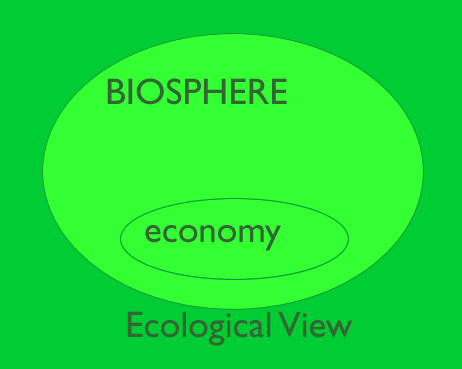
Harding finished with what he believed was the challenge facing our culture, the move from the conventional viewpoint which made the biosphere beholden to the “economy”, to an ecological viewpoint which makes the economy beholden to the biosphere. All this was a pleasant change from the business as usual paradigm I sensed at the Pugwash event. On reflection I don't suppose any of the speakers at the Pugwash event could really believe that we could continue with our current globalised capitalist economics - but didn't they have a duty to make that explicit? I understand from conversation with Stephan Harding after that talk that Lovelock uses the term "sustainable retreat" in favour of "sustainable development" which he considers impossible. The other great factor of Harding's talk in comparison with the Pugwash event, was how it showed science could serve a more integrated purpose, its radicalism was its greatest feature.

In the questions period after the presentation there was conversation about the absolute importance of localisation and community building, and also about the kind of global economics/politics that could best effect useful change - this quickly got into a conversation about TEQs (tradeable energy quotas), cap and trade, contraction and convergence and I have to admit useful as these schemes may be I always see these as more "market" solutions - and I'm not sure the market can truly solve this mess.

All the global economic tinkering -that's the 'big' stuff, the 'little' stuff is what we need to be getting on with - building those local networks, those communities - so shop local, get to know your neighbours start particpating in the future you want.

Wednesday, December 06, 2006

Climate Breakdown


Yesterday I went to an event to a public discussion ‘Climate Breakdown: Can it Be Controlled? Can We Prevent it?” arranged by the Pugwash Group. Pugwash is an international movement of scientists and others with a professional concern about the social impact of science and seeking ways to prevent its misuse (They are named after the site of their first meeting the village of Pugwash in Nova Scotia, and sadly have no connection to Captain Pugwash).

There were three speakers: Sir Crispin Tickell; Professor Peter Cox; and, (the big draw for me as well as other celeb spotters of the science world I suspect) Dr James Lovelock.

Lovelock spoke first on the theme ‘Global Heating: a hazard comparable to, or greater than, nuclear warfare’. I am pretty aware of Lovelock’s recent doomy prognostications despite not having read The Revenge of Gaia, nevertheless it was still quite sobering to hear what he openly described as his “apocalyptic view”.

He predicts that global warming (or global heating, as he pointedly referred to it throughout) will cause droughts, storms and floods that will make most of the world uninhabitable for humans. The resulting planet will “support only a remnant of current population” and they will be “driven to the Arctic”, “island refuges like the UK, New Zealand and Japan” and a “few continental oases” while the rest of the world becomes a “hot and barren desert”.

Lovelock believes that we must accept our limitations and realise that we are not qualified to become “climate regulators”, that it is “hubris” to think we can act as stewards or sustainable developers. International Agencies are not up to the task of dealing with the issue of global climate change and we must make efforts to “save ourselves” and make a proper managed retreat to the Arctic basin, island refuges and continental oases or else face the inevitable rout.

The other two speakers did not challenge Lovelock’s opinion, and one gathered that while he is at the extreme of current thinking – he is within current thinking. He may be using the most extreme modelling, but he is using modelling coming out of serious climate science.

Professor Peter Cox spoke on the theme ‘Climate change science: knowns and unknowns’ and provided a useful round-up of the certainties of contemporary climate science, the basis on which we make further extrapolations into the unknown. This was also pretty sobering stuff in itself, even when you’ve heard much of it before:

  • Global mean temperature has increased by 0.7 degrees C since the late 19th century. Most of this rise has occurred since 1980.
  • The ten warmest years on record have occurred since 1990. 6 of the 7 warmest have occurred since 2000.
  • No natural factors can explain the post 1980 warming. The warming is however consistent with anthropogenic effects.
  • Tropical cyclones have increased in destructiveness over the last 30 years.
  • A global rise in temperature of around 1.5 degrees C by 2030-2040 is now inevitable. Nothing we do now can stop that, decisions we make now will however decide the amount of temperature rise faced by future generations.
  • Future modelling scenarios show that by 2100 warming will be between 2 degrees C and 5 degrees C.
  • Realisation of many of the models, up to and including the one indicating a 5 degree C rise, would result in the total melt of the Greenland ice shelf and the concomitant sea level rise.
  • The change in climate we are looking at is on the scale of the change between a glacial and interglacial period, but will happen 10 to 100 times faster.

The third speaker Sir Crispin Tickell spoke on ‘The Political and diplomatic hazards’, I have to admit I was a little tired by this point, but he did seem a bit dull and to spend a lot of time name dropping all the famous politicians he’d spoken with and foreign places he’d been. The most interesting parts were his description of Mrs Thatcher as an “eco hero”, and his musings on discussions between China and India regarding glacial ice melt in the Himalayas, changes in monsoon pattern, and sea level rise – all of which will impact both countries massively. In order for real change to occur, Tickell suggested we needed 3 things:

  • Leadership from above.
  • Pressure from below.
  • A ‘benign’ catastrophe, which would prove cause and effect.


He hoped that those in the room would not be affected by the ‘benign’ catastrophe (I wonder how ‘benign’ a catastrophe he was considering). I used to think that a US based climate related catastrophe was the necessary tipping point in global consciousness, but how much has Katrina changed in the States?

I couldn’t stay for the discussion/question session unfortunately so I can’t report on that. I imagine that Lovelock’s support for nuclear would have come up. He did mention nuclear in his presentation, in a slightly contradictory sequence in which he suggested that the USA would respond to climate change with attempts at “techno-fixes” to buy time like sun shades in space or stratospheric particles. These, he said, would be attempts to carry on a business as usual model and wouldn't really be much help. He went straight on from this to promote the role of science and engineering in buying time for the habitability of the Earth and allowing civilization to continue – presenting nuclear energy as a techno-fix.

One thing I hope would have come up is the whole question of economic growth. There did seem to be an underlying belief amongst the speakers that “economic growth” should continue but within a low-carbon society. I think that this unspoken paradigm needed to be brought out in the open and discussed. Tickell did mention in passing that established models of GDP and GNP were misleading, that ‘externalities’ were ignored, and that we needed to think differently about economics, that the teaching of economics should be altered to reflect the global reality. He stopped short of saying what should take the place of what he thought should be removed however – hopefully this came up at question time.

So, all in all, a slightly depressing if informative experience. The solution part of the discussion was limited to Lovelock’s nuclear buy-time techno-fix, Cox’s get business on board with a 30 year business case model, and Tickell’s asides about a low-carbon society. Lovelock’s attitude regarding the ‘hubris’ of trying to act as stewards of the Earth, seemed to tar techno-fixers (Brown Tech and Green Tech in David Holmgren’s terms) and techniques for Earth recovery like Permaculture (Earth Steward-ship in Holmgren’s terms) with the same brush. To the questions the discussion title posed – can climate breakdown be controlled, and can we prevent it? I think the answers to both were “not really, but we may be able to slow things down”.

Never has the need for action been so pressing as now. Do what you can.