Showing posts with label Energy. Show all posts

Thursday, March 29, 2007

Wakey Wakey!!!

Been a bit slack here of late, but active offline. Attended the first "Transition City London" event on Tuesday this week at the LARC (London Action Resource Centre) in Whitechapel.

It's still hard to see how this would work on a city wide scale, especially in a city on the scale of London. A general feeling is that dividing the city by its boroughs would be an appropriate approach - which does split the city into more manageable sized units and works with rather than against pre-existing social and political structures. However London boroughs are also quite large units (too large?) and I wonder how identified Londoners are with their borough per se. Many Londoners live in one borough, work in another and perhaps socialise in one or more others... Well this is all stuff that needs to be worked through.

Meanwhile Transition Town Brixton is off the starting blocks, Sustainable Haringey is looking at Transition Culturing and if this stuff happens organically and from any grass roots level at all it's going to work much better.

Anyway here's some of the brainstorming over what a sustainable London might look like:


Excitingly there's also a UK wide tour of events "Wakey! Wakey!" trying to raise consciousness about Peak Energy just kicking off, learn more about it here.

ALSO: New FLICKR slide show of my photos in the sidebar ->
I've got other Permaculture related photos on the Naturewise FLICKR site.

Tuesday, February 27, 2007

Sites for sore Is

There’s been a slight site redesign, more forced on me than chosen by the “modernising” ethic of the new blogger… anyway that’s boring geekspeak, I’m falling asleep already myself. In the course of putting the site back together again I had to re-upload the banner links in the sidebar, and this seems a useful point to reflect on those:


The Oil Depletion Protocol

A Plan for a Sensible Energy Future...
As we move into an era of oil depletion and energy constraint, everything from transportation to medicine to food to climate change response strategies will be affected. Almost everything we do is dependent on oil.
The transition to a future of reduced oil supply will require the development of clean, reliable, and renewable energy sources and reduced oil production and consumption. The Oil Depletion Protocol will allow us to accomplish both - simply, conservatively, and cooperatively. It is a plan for a sensible energy future.”

The oil depletion protocol is a plan to move the planet through the end of the fossil fuel era by getting the countries of the world to sign up to a simple plan: oil importing countries reduce their annual imports by the global depletion rate; and oil exporting countries reduce their annual exports by their national depletion rate.

My good friend Keith has recently added a new e-petition on the 10 Downing Street website calling on the UK to sign up to the Oil Depletion Protocol; you can add your voice to the call here.

Richard Heinberg author of the book The Oil Depletion Protocol has been interviewed recently speaking on the subject here.


Irrepressible

This Amnesty International campaign seeks to show that online or offline the human voice and human rights are impossible to repress. Bloggers around the world are encouraged to carry the Irrepressible badge which will display material which has suffered from attempts at political censorship. Individual are also encouraged to sign up to a pledge on Internet Freedom. Learn more here.

Tuesday, January 09, 2007

It is poverty to decide that a child must die


It is poverty to decide that a child must die so that you may live as you wish.”
Mother Theresa of Calcutta


The “Money” section of Saturday’s Guardian newspaper had a half page article titled “The green revolution: Why wheat is luring the breadwinners” – which detailed how commodity dealers are taking advantage of the increase in global wheat prices.

After making millions from pumping up the price of copper, zinc and other metals to record levels last year, speculators are piling into “soft” commodities such as wheat and corn amid drought warnings and global shortages

Is this what they mean when they say the market will find solutions to the problems of global warming, fossil fuel decline etc.?

At present these increases in price are happily absorbed in the shopping baskets of the West, pence or cents on bread being almost invisible to all but the poorest parts of the American and European populations. The wholesale disengagement of price from value in the west, where discounting, loss leaders, sales, just-in-time delivery, e-commerce, globalised production, packaged products and services etc have confused everybody to the point of not understanding what anything is really worth anymore – have made the poorest parts of society practically blind to price rises in individual products too (Although Monday’s The Scotsman reports that “BREAD prices are set to burst through the £1-a-loaf barrier because of rising worldwide flour prices” seeing this as another burden on the British public already facing energy price rises, and increased mortgage payments due to interest rate rises). Avid readers will remember me touching on this issue last November.

In the Third World though these same price rises of staple foods can be devastating, and where they represent, as here, scarcity – inevitably lead to malnourishment, hunger and famine. If global climate change is responsible for the poor harvests, as it appears to be, then here we are seeing again how the poorest of the world, the wretched of the earth will feel the pain of our folly first.

Much is currently being written about how last years fall back in oil prices, reflected the Third World just being priced out of the market. Countries that cannot afford oil at $50 a barrel or above have just stopped buying - freeing up some supply for those who can, filling the gap between rising demand (in the West, China, India etc.) and static supply.

Climate change, peak oil – the world’s poor are acting as our buffer, but for how long? And what about the resulting effects – events on the Horn of Africa providing a current obvious example. Floods followed by drought in the late 1990s set the desperate stage for the actions that have followed in Somalia. The photograph of the dead child above is from the 1992 famine in Somalia, according to the World Health Organisation currently a quarter of Somali children die before reaching the age of five. Is it any wonder that people turn to extreme action, fundamentalist faiths in the face of this situation? As the USA bombs there, as another front of its “war on terror”, I wonder how many of the children who survive will grow up understanding their actions, understanding the behaviour of the West.

Tuesday, January 02, 2007

Low Energy Computing?


A couple of stories I saw today reminded me of the computer stuff I was going on about a while back. Sparked off by a Ran Prieur piece (Ran's site seems to be down in 2007 anyone know what's going on?).

Andrew Brown has an anti-Vista broadside on the Guardian online site, indicating the continuing inefficiency, pointlessness and greed associated with software upgrades. The raft of subsequent comments ran the point home.

This is put in further relief by the latest news regarding the $100 “One Laptop Per Child” project for schools in the developing world which should be launched this year. The BBC Online site notes:

The computer runs on a cut-down version of the open source Linux operating system and has been designed to work differently to a Microsoft Windows or Apple machine from a usability perspective. Instead of information being stored along the organising principle of folders and a desktop, users of the XO machine are encouraged to work on an electronic journal, a log of everything the user has done on the laptop.”

Apparently the machines will be powered by a 366-megahertz processor from Advanced Micro Devices and have built-in wireless networking. They will have no hard disk drives and instead use 512 MB of flash memory, and have two USB ports to which more storage could be attached.

This could be exactly the kind of stripped down computing we should be aiming for on a grander scale. Hopefully these small machines will be lower energy users, there has been talk of wind up models – solar power would be another obvious winner if the technological and sustainability hurdles can be leapt over. The One Laptop Per Child Wiki suggests that a retail version may become available for sale to help cross subsidise the units sent to the developing world. These apparently may have some enhanced capabilities such as built-in Ethernet and extra flash RAM.

Thursday, December 14, 2006

Together in Electric Dreams

If we accept that we face a future of energy descent, and/or that our current profligate use of energy is contributing to global climate change (and I think we accept both right?) then we must use less energy.

Using less - and ideas of reduction can be unappealing and hard ideas to sell. Most of us, even those of us who accept a need to use less energy would prefer to keep as many of the benefits of modern convenience as we can. Therefore we want to find the most efficient ways of doing things while minimising any increase in the intensity of labour. So, given that we already turn everything off at the wall when we’re not using it, never use standby, have replaced our light bulbs with leds - what else might we do to bring our electricity demand down?

Washing your clothes

Rob Hopkins pointed out recently in an entry at Transition Culture the great advantages which the washing machine has brought. The labour of hand washing is certainly a real grind which most people would be pleased to avoid. So what can we do to make things better?

1) If you buy a new washing machine you must go for an A+ energy rated one – and use a full load.

2) Sharing a washing machine can be more efficient, especially using the industrial models found in launderettes – in the future it would be good to see installation of these type of machines in communal areas of housing.

3) You could try using an electricity free model like the Wonder Wash, which depends on your physical labour but increases its efficiency. I have no experience of these yet, but this seems worthy of investigation. In the UK you can buy them from here.

Drying your clothes

Now you’ve washed your clothes – they’re wet and you’ve got to get them dry. Lots of people use a tumble dryer – its easy, its independent of weather conditions, it also uses a lot of energy. So what are the options?

1) A clothes line obviously – but in the cool, wet temperate regions of northern Europe in winter time, this is not always a go-er. I recently read about this clothes line contraption, which if you’ve got the space may provide a solution to getting things dry even when it’s raining.

2) A spin dryer is a good way of extracting a lot of the water from your washing, and use far less energy than a tumble dryer. It uses centrifugal force to extract the water. This is supposed to be a resilient model. As others have pointed out, there should be a way of fixing something like this up to a static bicycle, thus using human generated rather than electrically generated kinetic energy and providing an exercise opportunity to boot.

Keeping food and drink cool

This is obviously more of an issue in warmer climes and the warmer months, but there are plenty of items which will keep longer, keep fresher or just be more appealing if we can keep them cooler.

1) In a climate like the UK, there is much to be said for the traditional larder – on the cool side of the house, allowing air to circulate around the foodstuffs can obviate the need for a fridge for much of the year.

2) There are some “high tech” developments taking place using magnets to create a more energy efficient refrigerator, these are still in development however and I prefer the lowest tech solution we can come up with.

3) Which brings into play the Zeer pot or pot-in-pot ‘fridge’, a beautifully simple use of thermodynamics and basic materials – two terracotta pots, sand, water – to achieve a way of keeping food and drink cool.

Making a cup of tea


Anyone who has looked at the wattage of the average kettle, or watched their electricity meter spin while their kettle boils will know how much energy these use up.

1) One thing I’ve enjoyed the use of recently is the storm kettle; this provides a quick way of boiling water using a small amount of combustible fuel. May mean you have to go outside to boil the kettle – but hey what’s wrong with outside?

OK, so now you can wash and dry your clothes, keep food cool and make a cup of tea all without using electricity. What’s next?

Friday, November 10, 2006

Engines of Indifference?

For the first time in print, I’ve seen someone express how I feel about progress in computing – its from good old Ran Prieur in his November 9 entry, where he calls for an end to the wasteful use of processing power that’s become endemic:

“The people who most want to save high tech are doing the most to crash it, by reaching for more and more candy instead of working to build the stability that any enduring system needs. If we're going to have computers in 200 years, a computer maker has to say something like this:

We're holding the line at 1Ghz and 512MB RAM. We're going to keep making them that powerful forever. Instead of "improving" in speed and size, we will work on reducing energy consumption, reducing weight, making components that have less ecological footprint, last longer, and are easier to repair. And software designers for our machine will have to stay within the same technical limits, and make improvements in elegance and creativity. In 1000 years, our 1GHz machines will be hand-made from quartz crystals for five cents each, use captured sunlight instead of electricity, and beam pictures directly into your brain. That's progress, baby.


A lot of my thoughts on this have their origin in me pondering on two things:

1) Computers in the USSR. Due to cold war trade embargoes, and restrictions on knowledge transfer, the USSR could not benefit from many of the forward strides in computing power being made in the West. However faced with poorer spec’d computers, their programmers had to become amazingly efficient and imaginative in order to get the machines to do what they wanted – with the end result that Soviet computer programmers were real geniuses. Now – is it better to have lower-tech, less intensity machines having their utility maximised by intelligent operators OR is it better to have high-tech, high intensity machines, that are bloated in order to require less intelligent operation? Every decrease in memory/processing power cost brings PCs with more memory/processing power which is immediately used up by hungrier programmes – most of which are performing the same tasks a previous software generation did at a lower use of memory/processing power. There is no incentive for programmers to hack down the software to use as few resources as possible to do the task at hand, they have just depended on Moore’s Law to save them the bother and spew out these lardy new products that gobble up all the gains.

2) Influenced by the idea of Steampunk science-fiction, I often ponder how effective “old”, “outdated” technologies would be if now revisited with modern knowledge and materials. e.g. How efficient a timber driven steam engine could you make now? What new characteristics and abilities could ceramics and aluminium foam or Kevlar and other modern synthetics bring to these “outdated” way of doing things? Could they actually be more efficient than modern methods, or have other beneficial characteristics – e.g. in terms of health and safety, environmental impact, cost etc.??

As we move into an energy descent future, these are certainly areas we are going to have to look into – and how exciting that could be – isn’t this the real challenge of science and technology that inspired the great thinkers?

IMAGE: The London Science Museum's replica difference engine, built from Charles Babbage's design.


Tuesday, October 31, 2006

Round 'em Up


Roundup of stuff time, Rob Hopkins has also posted about David Suzuki over at Transition Culture and made some interesting comments as ever, well worth a read.

An unexpected guest speaker at my permaculture course this weekend was Donnachadh McCarthy , author of Saving the Planet Without Costing the Earth. He had a lot of interesting things to say. A couple of little practical ones:

1) lots of people I know have avoided getting eco-light bulbs because they don’t work with dimmer switches, well now there are some that do – made by Megaman and available through a number of retailers, another course attendee recommends lamps2udirect (thank Geralyn!).

2) Seems that there’s an increasing body of evidence of very low outputs from domestic wind turbines in urban settings. Donnachadh is a pro-renewables voice, and has his own turbine – so I think we can trust him on this. This is particularly concerning given that B&Q are making the big push now with wind, perhaps while the technology is still in its infancy. While there is a good symbolic role in people taking on this technology, it could backfire terribly if lots of middle class people buy £1500 machines and get very little out of them except vibration damage to their roofs.


A note on Energy Bulletin directed me to this promo for the ASPO film Asleep in America on YouTube.


Friday, October 27, 2006

Nice Try but No Cigar

A major flood at ‘Cigar Lake’ a Canadian uranium mine has further restricted future supplies of the radioactive poison, believed by some to be out energy saviour. Prices have increased again, after having already gone up 54% this year.

From the Bloomberg story:

"Losing Cigar Lake in the uranium world is like the oil market having to deal with the loss of Saudi Arabia,'' Kevin Bambrough, market strategist at Sprott Asset Management Inc. in Toronto, said in an e-mail. Projected full production of 18 million pounds annually at the mine "equates to just over 10 percent of current annual consumption,'' Bambrough said.

As I’ve mentioned before, Canada is the number 1 source of the world’s uranium (30% of world supply), number 2 (or 5 according to this report) is Kazakhstan. The EU is currently courting Kazakhstan to get its hands on more of its supplies of radioactive poison. Let’s hope that human rights were discussed too. How exactly is going nuclear going to increase our "energy security"?

I’m kind of hoping that all the political embarrassment around Borat will be a major factor in derailing a nuclear future.

Just to keep you up to date with the UK nuclear industry (and derailings), here's some of the last weeks goodies: Sunderland train station was evacuated on Wednesday when a train carrying nuclear waste to Sellafield broke down; Hinkley Point B Nuclear power station's two reactor may never re-open after being closed due to problems including "cracks in a reactor's graphite core, and cracks in boiler pipes"; the UK nations are getting into a bitchfest about who has to look after nuclear waste; while Environment Secretary David Milliband is trying to bribe local councils to bury the radioactive poison in their backyards.

Click here for the Europe wide million signature campaign against nuclear power.

Tuesday, October 17, 2006

Intelligent thought needs huge expansion


Keith's just pointed out a BBC story Nuclear needs 'huge expansion', where one John Ritch, director-general of the World Nuclear Association says that the world needs a 20 fold expansion in the use of nuclear power in order to prevent climate change.

The article is pretty even handed and it's interesting to see the peak uranium theory getting a BBC airing. I can't see much confidence in the "positive" view put forward in the piece by the OECD's Nuclear Energy Agency, which suggests that there is 85 years-worth of uranium in the ground at "current rates of use" and pays no attention to the energy cost of the nuclear cycle. Looking at fossil fuels has taught us that there becomes a point when the EROEI makes further extraction of an energy source counter-productive. This point is covered in the piece by comment from David Fleming.

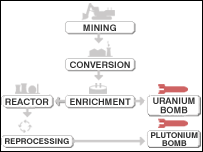
I've touched on the relations between nuclear power and nuclear weapons here (and here) before, and its good to see that Friends of the Earth are given space to mention this in the article.

In a week that's seen confirmation of North Korea's nuclear test, Sellafield nuclear processing plant being fined for a leak of 83,000 litres of acid containing 20 tonnes of uranium and 160kg of plutonium, and the discovery of cracks in several UK nuclear power stations - one wonders how the insanity of nuclear energy still holds forth. Also bear in mind that this is just the stuff we're told about, the UK nuclear industry is notorious for its use of 25 year rule, d-notices etc. to hide its biggest fuck ups.

Friday, October 06, 2006

What's Farsi for "Nein Danke"?

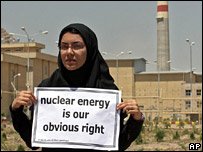
Iranian Student outside Isfahan Nuclear Facility
I'm against pretty much all the nuclear industry - weapons, energy the whole lot. I just don't think we have the right to go on producing poisons that will last millennia after our deaths, or that it can ever be right. It's not essentially a spiritual point of view, or a personal philosophical point of view - it's a pragmatic acceptance that creating elements, not seen before on Earth, that have the power to kill for hundreds of centuries is likely to be a bad idea.

That said, I don't really see that the "West" has come up with any reasons good enough to stop Iran from developing nuclear technology. If the rest of the world was retreating from nuclear energy and nuclear weapons there would be a clear global moral argument against any new development. Also there would be fewer atomic scientists, less atomic material, less nuclear expertise and technology to "go astray".

In fact the opposite is the case - the "west" and other countries in the favour of the "west" are gung-ho for new nuclear energy developments. It is increasingly seen as a solution for avoiding global warming, and for assisting in energy security (i.e. dealing with all the oil running out, and what's left mostly being owned by people who don't like us). Now if you were a country whose whole economy depended on fossil fuel exports and you had already passed your own peak oil production point wouldn't you want to join this new energy bandwagon before it was too late?

In terms of nuclear weapons, the "west" similarly shows no sign of retreat. The US military pushes for the development of "tactical" nuclear weapons, atomic bunker busters et al. The UK government gets ready to spend billions on a new nuclear weapons system to replace Trident. Meanwhile countries like Israel, India and Pakistan are allowed nuclear weapons without censure. Iran looks on and sees that while a country without any evidence of WMD (Iraq) is invaded and turned into a pit of chaos, a country that clearly does have WMD (North Korea) is pussyfooted around. Doesn't this indicate that you bloody well better actually have WMD if you want to avoid the USA coming a shit kicking?

So we have an opportunity to stop Nuclear madness here and now, stop nuclear development in the first world and export the moral argument (and the supporting details on peak uranium). Simultaneously we restrict the number of people who possibly could create nuclear industries, and the technology to allow us to do so. Our Atomic scientists will have plenty of exciting work left to do, working out how to make all the crap 50 years of nuclear activity have generated safer for the unborn generations who will share the planet with it.

Tuesday, September 05, 2006

Driven by Oil

For Your Oil Only

The BBC is back on the case of oil with a new four part series on Radio 4 “Driven by Oil”.

The first episode “When will the Tap Run Dry?” was broadcast on Monday September 4th, and is currently still available via the listen again feature. This episode focuses on the peak oil issue.

The second episode “The China Syndrome” to be broadcast on September 11th looks at the new demand for oil and the impact of emerging economies such as China and India.

IMAGE: For Your Oil Only lifted from Tropical Boy

Thursday, August 31, 2006

Jeremiad


Just back from Barcelona, living the good life for a while. How many more years will that be possible? Not that I think that life will be "bad" per se, but it's difficult to be entirely optimistic. And this kind of week long city break using cheap airlines is almost certainly in its final days. I read Derrick Jensen's A Language Older Than Words while away, which is a truly great book - and I'm now started on Book 1 of his new Endgame opus. Dig the pic? I do, it accompanies a new interview with Kurt Vonnegut in the latest Rolling Stone in which he adds his voice to the peak oil debate "What's going to happen is, very soon, we're going to run out of petroleum, and everything depends on petroleum". You can read some of the piece "Vonnegut's Apocalypse" online. Squeezed out another maudlin poem "Jagged Mountain" while away, you can read it over at Rubedo.

Thursday, July 20, 2006

It's getting Hot in Here

last hours of ancient sunlight
So take off all you knows.

I don't have to search for oil and energy stories these days - you can't move for them. Israel's actions in Lebanon have provided the latest ostensible reason why oil prices have increased, which even if true - only reflects how tight supply is.

Europe's super heated days not only seem to tell a global warming story but have sent wholseale electricity prices spiralling - and given further indication of how tight the global energy system may be. Fridges and fans and air-con have sent demand right up and the power companies are struggling to maintain supply - France (the great avatar of energy independence, based on its nuclear stations) imported electricty from Italy. The severe heat apparently compelled France's energy company, EDF, to lessen electricity generation at some of its nuclear power stations, as the coolant water it draws on was too hot.

At the ASPO conference currently running in Pisa , Chris Skrebowski, the editor of Petroleum Review gave his latest prediction as to the date of oil peaking. He said: “We have 1,500 days until peak and tomorrow we’ll have one day less.” (that was said on the 18th July, so as of today its 1,498 days by his reckoning). On a further cheery note, at the same conference, Dennis Meadows (one of the authors of Limits to Growth) told the audience: “We have already overshot. Collapse is not inevitable but it will very tough to avoid.”

I've got a new poem over at Rubedo:
Rubedo: Post War Dividend

Monday, May 22, 2006

Where does atomic energy come from?


I'm personally not getting all the information I want on the Nuclear energy issue, you probably aren't either, so I'm going to save you from too much googling and try and compile some relevant data here.

The chart shown is from the report Uranium 2003: Resources, Production and Demand, updated 2005 produced by the Nuclear Energy Agency (NEA) (a specialised agency within the Organisation for Economic Co-operation and Development (OECD)) .

So this is where the uranium comes from. I guess that the UK government feels that nuclear sourced energy is more secure than gas secured energy, because we can depend on Australia and Canada better than we can depend on Russia. This is what is indicated on the Nuclear Industry Association sponsored Energy Choices website: "there are many potential source nations, several of which have long histories of political stability (for example Canada and Australia). "( I think "many" might be pushing it, the OED defines many as being a "great (indefinite) number of"). Elsewhere the website tells us "Although uranium for nuclear energy has to be imported, there are no supply problems relating to price instability or countries of origin." (It doesn't back this up with why it thinks this are dependable statements for the future though - why not watch the price "stability" yourself at the UX Consulting site (The price of uranium has quadrupled since mid-2003) ).

So how long will this uranium last? The Uranium Information Centre Ltd (an organisation funded by companies involved in uranium exploration, mining and export in Australia) in its 2003 report Nuclear electricity states that "The world's power reactors, with combined capacity of 350 GWe, require some 75,000 tonnes of uranium oxide concentrate from mines (or stockpiles) each year. "

3,622,000 tonnes supply divided by 75,000 tonnes annual usage equals 48 years (and a few months) worth of uranium. Or based on the fact that these reports were written in 2003 - global uranium will be completely depleted by 2051. The poisonous waste produced in this period will then remain radioactive for 1,000 to 10,000 years (on the Energy Sources website its states that "Radioactive decay of spent fuel is very marked in the first 1,000 years and before about 10,000 years the fuel's radioactivity can have reduced to the same level as the original ore which was mined to produce the fuel in the first place"). In other words, if we'd used up our hundred years worth of uranium around 8,000 BC, we could stop worrying about the radioactive waste about now.

Of course this 48 years figure is based on two assumptions:

1) that we wont increase our known recoverable sources of uranium.

2) that we wont increase our demand for uranium.

So let's look at these assumptions:

1) Our friends at the Uranium Information Centre have some information about this on their FAQ page:

"But aren't world uranium resources too limited to sustain a big expansion of nuclear power?
No, while known and quantified resources are only about 50 times annual use, there is every indication that ongoing mineral exploration activities will steadily increase known resources, as they have in the past with all metal minerals."

I mean its not very detailed information, but perhaps it makes you feel better.

The World Nuclear Association (organisation "representing the technology, people and organisations of the global nuclear energy industry") has some more comforting news for us:

"It is now clear that uranium is not scarce and it is known that it averages almost two parts per million of the Earth's crust. There are substantial resources that are not yet fully proven. These so-called speculative resources are likely to be of the order of 10 million tonnes, about three times the known reserves. While prices remain low, there is no incentive for exploration activities to identify new deposits. Experience with other commodities has shown that increased demand has led to increased prices, and a subsequent increase in exploration and discovery."

Personally I'd be looking for some harder evidence that these "speculative resources" exist, and that it would ever be economically viable to extract them - but perhaps this is enough for governments to make their energy decisions on...

Not everybody is convinced though. Two independent experts, Jan Willem Storm van Leeuwen and Philip Bartlett Smith have a different view, reported recently in The Times and available in its fully researched form in their document Nuclear Power: the Energy Balance (August 2005). The Times report, summarises


"They say that at the present rate of use, worldwide supplies of rich uranium ore will soon become exhausted, perhaps within the next decade. Nuclear power stations of the future will have to reply on second-grade ore, which requires huge amounts of conventional energy to refine it. For each tonne of poor-quality uranium, some 5,000 tonnes of granite that contains it will have to be mined, milled and then disposed of. This could rise to 10,000 tonnes if the quality deteriorates further. At some point, and it could happen soon, the nuclear industry will be emitting as much carbon dioxide from mining and treating its ore as it saves from the “clean” power it produces thanks to nuclear fission."

2) Well we will obviously increase our demand if the world chooses nuclear as its 'way out' of its energy impasse. A recent report in the Guardian "Price of Uranium Soars" lays it out cold:

"Britain's planned nuclear programme could be hampered by a lack of fuel as the price of uranium soars on world markets. This reflects fears of future shortages after a resurgence of interest in nuclear power - not just in Britain but also in Finland, France and the US, where new plants are going ahead. China wants to build as many as 30 plants by 2020, helping to push the price of uranium oxide from a low of $6.70 a pound at the start of 2001 to $41.50 yesterday."

I can't find a source that suggests that global demand for Uranium will fall.

This all seems to add up to me to mean that the amount of economically recoverable Uranium will not significantly increase, while the demand for nuclear fuels will increase, alongside the demand for all other fuels. So if we globally choose the nuclear option, our fuel supply will run out before we're halfway through the century - and the point of 'Peak Uranium' will come much sooner. For more details check out David Flemings article in Prospect magazine, and the Nuclear Facts in New Internationalist magazine. If these sources are all a bit left wing wishy washy liberal for you, why not check out the International Atomic Energy Agency's report Analysis of Uranium Supply to 2050. I tell you now, it's not an easy read - but turn to p.66 and look at Table XLVII, where it gives information on the "First Year of deficit compared with market based production requirement"(i.e. when demand exceeds supply) for highly enriched Uranium. This seems to put Peak Uranium at between 2034 and 2036.

I've left some facts out and you can go research these if you are interested. We don't get all our daily usage of Uranium from mines, we get some of it, according to the UIC FAQs "from Russian weapons stockpiles - recycled warheads, and in fact one tenth of all US electricity is from that source." Apparently you can also build nuclear reactors that use Thorium instead of Uranium, and we've got plenty of Thorium - but there are no reactors currently built or planned to be built that use Thorium.

Friday, May 19, 2006

Mid May Meanderings


Haven't had the energy (renewable or non-renewable) to come up with a decent entry. The markets are sliding . I understand, this may have to do with US interest rates, which may be raised to head off inflation or something. Inflation provoked by higher energy costs. What does this mean?

Meanwhile the South-East of England where I'm currently domiciled is facing "drought", this water thing has been bubbling away (if you'll excuse the pun) for a few years now.

Evo Morales and Hugo Chavez have been having their wrists smacked by the EU for choosing not to follow the privatise everything and put it in the hands of big business ideology that we all love to hate - of course taking back their energy fields is not popular. To tell you the truth, I can shake the rumba for Chavez and Morales with the best of them - but I actually know so little really about them or the politics of the region that they could both be ego-mad dictators in waiting who will just fuck over their peoples like everyone else given half the chance. You know its fun to like Castro as a great resistor of US hegemony, but you've got to feel anxious that he's not an elected figure and there's a whole lot of stuff you'd rather not hear like the oppression of gay people etc. We don't need another hero, as Tina Turner put it.

Keith just linked me up to this bit of cynicism. I could read this kind of stuff all the time, gimme some truth man. Like Michael Ventura with his Letters at 3AM for the Austin Chronicle, or James Howard Kunstler's Daily Grunt, and weekly Clusterfuck Nation Chronicle, or Charlie Brooker's Screen Burn , Julian Cope's Address Druidon. Write and tell me about some more cynics for me to seethe with.

Still making my way through The Cloudspotter's Guide so I'll tell you about that later.

Wednesday, May 17, 2006

The Nuclear Option


Tony Blair’s finally done it, at a speech to the CBI, and come out for Nuclear power.

This does feel like some line drawn in the sand, any faith we might have had in government eventually waking up to what is really going on and acting appropriately seems to have gone out the window.

Its grassroots activism all the way now, fighting every battle as it comes along, while we do our best to change everybody’s consciousness. The media has represented the “anti-nuclear” resistance in reporting this story - largely it appears through the figure of Tony Juniper of Friends of the Earth. He’s had lots of important things to say, but I feel that in these soundbite times we have to prioritise our expressed reasons against these developments.

Talking about the terrorist threat created by having more potential nuclear targets, and the hypocrisy of our position over Iran when we choose more nuclear power are points that are all well and good. But in those brief moments of reply afforded by the media, it seems to me that the anti-nuclear resistance should concentrate on destroying the pro-nuclear arguments on its own terms, I.E.:

1) That its a low carbon solution - some pithy way of highlighting the carbon emissions across the lifecycle of nuclear power generation needs to be found.

2) That it deals with problems of energy security - there is never any mention about Uranium imports, or being dependent on foreign supplies of nuclear materials & technology, or the competition for nuclear materials.

3) That its a long term solution - lets foreground global supplies of uranium and the “peak uranium” concept.

4) That its a business as usual solution - even with nuclear, a radical decrease in our energy usage is essential.

Looks like we’re going to have to fight them on the beaches, and the estuaries and anywhere else they want to build one of these tombstones.

(This was originally posted as comment to an entry over at the excellent Transition Culture)

Friday, May 12, 2006

Gas Again Sucker


The official line on the future of our Gas supply seemed to me to be: there's some short term problems right now with supply, they will quickly be sorted out in the next couple of years - Russia's got masses of Gas, once we can pipe it in, prices will go down and we can all forget about it. A few worries about the political influence Russia could wield if Europe is so energy dependent on it have been downplayed with a Russia needs us more than we need Russia angle.

OK, lets accept that point of view for a while then - Russia won't gain any political leverage on us (or cut us off at the drop of a hat like the Ukraine or Georgia) and we can depend on a nice load of cheap gas from there for the politically expedient future. Great.

Then I read this in yesterday's Guardian. Where comments made to MEPs and senior EU officials at the European Enterprise Institute - by Eric Berglof, chief economist at the European Bank for Reconstruction and Development - are recorded. Berglof told them that Gazprom, the Russian gas group majority-owned by the state, would struggle to offset declines in output, but demand from Europe and ex-Soviet Union countries would grow at 2-3% a year. Apparently 70% of production at Gazprom, the world's third-largest energy group, comes from fields whose gas is running out.

Read the whole article for more bad news. If you can really be arsed you can read one of the other presentations given at the event by Christian Cleutinx, the Director of the EU-Russia Energy Dialogue at the European Commission. Obviously these people have there own little axes to grind etc. But they aren't your usual suspects are they? The range and number of voices now indicating or hinting at a forthcoming energy crisis are growing day by day.

Have you insulated your loft yet?

Thursday, April 27, 2006

Nuclear


The 20th anniversary of Chernobyl is a useful warning against nuclear power in these days of increasingly gung ho attitudes towards the atomic(both energy and weapons).

To focus on the disaster as a reason to avoid nuclear power is a trap however that will just draw us into endless discussion about their reactors and our reactors, and lax Soviet safety measures - and generally just keep the debate in the quagmire.

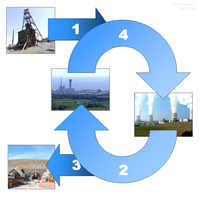
The reasoning against nuclear power stand even without Chernobyl of Three Mile Island. All the energy and carbon release involved in mining and processing the fuel, building the power station, decomissioning the power station and looking after the waste for centuries.

In the UK there is currently estimated to be 470,000 cubic metres of radioactive waste for which at present no clear option exists (including 2,000 cubic metres of "high level waste", 4,300 cubic metres of Plutonium and 75,000 cubic metres of Uranium). It seems that "deep burial" is still the favoured waste solution, and obviously not everyone is convinced.

Wednesday, April 26, 2006

Gas


George Monbiot was back on the energy case in a piece in yesterday's Guardian (see the same piece with footnotes at his own site). I still feel pretty uncertain about the "hydrogen economy", but Monbiot is coming at it from a more informed position than most.

This section of his piece is, I feel, the most important one to consider:

"The problem comes down to this: that our homes, whose consumption has grown by 19% since 1990, now account for almost one-third of the energy the United Kingdom uses(8). Of this, only 18% is used for lights and fridges and TVs and the other electronic gadgets with which we now fill them. All the rest is used for space and water heating(9). In the domestic sector, the big issue is not electricity but heat.

I’ve looked into every source of sustainable heat I can find, and while there are plenty that could supply some of our houses – wood and straw, solar hot water panels, district heating systems and heat pumps for example – all of them are constrained by one factor or another, such as a shortage of agricultural land, our feeble sun and the disruption involved in fitting them to existing homes. It seems that there is only one low-carbon source of heat which could (with a massive investment in new infrastructure) be supplied to most of the homes in the United Kingdom between now and 2030. It is hydrogen."

As I say, while I'm still not totally convinced by the Hyrdogen angle, I think that Monbiot is doing good service to the realpolitik of the energy situation by asking these questions about our future heating needs.

Monbiot's question marks about the UK's gas future should usefully be read alongside Rob Hopkin's in a recent post at Transition Culture.

Tuesday, April 25, 2006

Oil


Oil, energy is there really any other story these days..? Not that the mainstream media is giving it it's due. Stories are out there if you want to find them, mainly in the financial/business pages. The rising price of oil is always explained by a few local difficulties here and there - Iran/USA squaring off, Nigeria this, refinery that - never a question that some kind of peak in supply has been reached.

That said, you're increasingly hearing some brief aside on supply and demand tagged on the end of the thises and thats, not dwelt on - just left hanging, like its of no real consequence. Today BP chief Lord Browne said soaring crude oil prices "may well create petrol prices above a pound a litre".

The BBC reports:

'BP chief executive Lord Browne said that oil prices "are expected to remain strong".
World economic growth appeared "robust", Lord Browne said, while "ample" stocks and increased output from the Opec oil producers' cartel have failed to stem price rises. '

That's pretty typical - Demand is "strong", supply is "ample". Its a few years now since my Economics A-Level, and maybe things have moved on, and are more complicated etc. But I remember pretty clearly nice simple graphs for price - supply across the bottom, demand up the side - where the two meet - Price.

But the story always seem to be these days that the price is a false signal, so what factor on the graph is wrong - Demand? everyone seems to agree this is growing, China, India etc. - or Supply?