Showing posts with label Music. Show all posts

Friday, March 02, 2007

Orphic Trinity - Orphic Resonance

Last night I attended the first of the Gaia Foundation’s 2007 evenings, this one with Brian Goodwin, leader of the MSc in Holistic Science at Schumacher college (and thus a close colleague of the previous speaker Stephan Harding’s whose talk I covered here).

As you would expect there were many parallels with Stephan Harding’s talk, and both were based around new publications – in Harding’s case Animate Earth: Science, Intuition and Gaia, in Goodwin’s Nature’s Due: Healing Our Fragmented Culture. Both speakers made the case for holistic versus reductionist science and for a reappraisal and acceptance of animism – the belief that a “soul” or “spirit” existed in every object, even if it was inanimate.

Goodwin asked us to reconsider the stories of science, by telling different stories we find a different path. Following a Jungian, archetypal model Goodwin identified a “new” story that has emerged in our culture, which is actually the re-emergence of an old story – which alters our perceptions on science and opens up through animism a new connection with nature. This story is the myth of the Orphic Trinity – Chaos, Gaia and Eros.

Verily at the first Chaos came to be, but next
wide-bosomed Earth, the ever-sure foundations of all the
deathless ones who hold the peaks of snowy Olympus, and dim
Tartarus in the depth of the wide-pathed Earth, and Eros,
fairest among the deathless gods, who unnerves the limbs and
overcomes the mind and wise counsels of all gods and all men
within them
.”
Hesiod, Theogeny (c.700 BC)

Goodwin posited the era of the 1960’s as the genesis point of this archaic revival, first with the re-emergence of Chaos in the work of mathematician Edward N Lorenz. Lorenz attempting to apply mathematical modelling to meteorological phenomena and weather prediction discovered that apparently small changes in initial conditions produced large changes in the long-term outcome. These variations in initial conditions could be so numerous and so slight that they made accurate prediction of future effects impossible. What he described as Deterministic Nonperiodic Flow has become better known as Chaos and has become an important part of mathematical and scientific enquiry. It would appear, as some anarchists and magickian’s claim: that “chaos never died”.

"Does the Flap of a Butterfly's Wing in Brazil Set Off a Tornado in Texas?"
Edward N. Lorenz, paper delivered to the American Association for the Advancement of Science (1972)


For the mass of practicing scientists... the change did not matter immediately... But they were aware of something called chaos... More and more of them realized that chaos offered a fresh way to proceed with old data... chaos was the end of the reductionist program in science.”
James Gleick, Chaos: Making a New Science (1987).


The second element of this archaic revival was the re-emergence of Gaia in the pioneering earth systems science work of James Lovelock and Lynn Margulis. This work finally gained its crucial nomenclature as a result of a conversation between the neighbours Lovelock and novelist William Golding in 1969.

Most of us sense that the Earth is more than a sphere of rock with a thin layer of air, ocean and life covering the surface. We feel that we belong here as if this planet were indeed our home. Long ago the Greeks, thinking this way, gave to the Earth the name Gaia or, for short, Ge. In those days, science and theology were one and science, although less precise, had soul. As time passed this warm relationship faded and was replaced by the frigidity of the schoolmen. The life sciences, no longer concerned with life, fell to classifying dead things and even to vivisection. Ge was stolen from theology to become no more the root from which the disciplines of geography and geology were named. Now at last there are signs of a change. Science becomes holistic again and rediscovers soul, and theology, moved by ecumenical forces, begins to realise that Gaia is not to be subdivided for academic convenience and that Ge is much more than just a prefix.
James Lovelock, “What is Gaia?

The final element of the trilogy is Eros, the force of love, also known as Eleutherios, "the liberator" and through that shared role connected with Dionysus – god of intoxication, music, peace, the civilizing urge – and thus also connected with Orpheus and the Orphic mysteries (I wrote about some of this previously in The Rebirth of Orpheus over at Rubedo). Goodwin asked the audience “who here lived through the 1960s? Can you recognise anything familiar here in the aspects of this deity?”

THE COURT: "Erotic," did you say?
THE WITNESS: Erotic.
THE COURT: E-R-O-T-I-C?
THE WITNESS: Eros. That means love, your Honor
.”
From the Court Testimony of Timothy Leary at the trial of the Chicago 7 (1970)


Love, love, love.
Love, love, love.
Love, love, love.

There's nothing you can do that can't be done.
Nothing you can sing that can't be sung.
Nothing you can say but you can learn how to play the game.
It's easy
.
Lennon/McCartney, All You Need is Love (1967)


Goodwin indicated that we are still in the process of integrating these archetypal forces into our science and into our culture, with the attractive force of Eros suffering from most neglect.

The discovery of DNA by Rosalind Frankin (Crick, Watson, Wilkins etc.) in 1953, with its beautiful double helix formation began a quest in the biological sciences to decode the organism and gain some total understanding of life. Goodwin quoting Evelyn Fox Keller’s The Century of the Gene presented the case that the completion of the human genome project had, rather than bringing such a total understanding, in fact revealed how large the gap is between genetic information and biological meaning. How the particular structure of organisms develop largely remains a mystery, there is some embodied meaning in the cells which is inaccessible to consciousness. Goodwin posits that the development and organisation of form by cellular DNA occurs through the action of a kind of language – and that particular forms are the stories told in that language.

Thus herbalists may develop the ability to read the story of a plant as manifest by its form and intuit the qualities of that plant. The holistic enquiries of wise women and cunning men from the era before reductionism took hold may have genuinely born a “shamanic knowing” that is not only dismissed by our modern science but is beyond its conception. Goodwin stated that meaning is “immanent” not “transcendent” – when science attempts to de-particularise and abstract, it in fact moves further from rather than close to meaning.

So Goodwin asked, how do we engage with this? How do we go about re-integrating this sense of nature in our science and culture? How do we achieve harmony with our fellow entities? Relating this back to the Gaia Foundation’s work and the influence of theologian Thomas Berry, Goodwin suggested that by beginning to change our conceptions we participate in a greater change in consciousness, that this is part of “engaging in the great work” – the alchemical transformation of ourselves and society – the paradigm shift which might be understood as the Magnum Opus.

Monday, December 11, 2006

Grizzly Men

I’ve been a fan of Werner Herzog since some point in the 1980s when I saw Aguirre, Wrath of God on TV. I think it was during the great reign of Alex Cox on Moviedrome, when a stuck at home teenager could depend on a regular stream of the coolest, weirdest cult films coming out of the television (although on researching this it appears that Moviedrome never featured Aguirre!). Nowadays, the dvd bonanza of reissues, and bit-torrented div-x’d whatever’d video files shared online provide a very different route in. Maybe there’s more access now, but there is a lack of the personal curatorship that a Cox would bring to your viewing.

I’m not sure what the next Herzog film I saw was, but the next revelation for me was starting to catch his documentary work. Amazingly inspiring films, and it was amazingly inspiring also that he worked in both fiction and non-fiction modes. It created in me a new sense of what a modern film maker could be, what a film maker could achieve.

This weekend I finally got around to watching Grizzly Man his recent documentary, after picking a used copy up cheap at the local video store. What a pleasure it was to sit down again and hear the warm, pleasant tones of Werner’s voice as he brought another story to life.

By now you probably know something of the story behind the film, even if you haven’t seen it: Timothy Treadwell a minor actor with an alcohol problem finds himself in an environmental crusade to save the grizzly bear, which over a span of 13 years sees him living in ridiculously, dangerous proximity to bears every summer. He captures amazing footage of the animals, gets to know them, the local ecosystem and their patterns of behaviour – until he and his girlfriend are killed and eaten by one of the bears.

The legacy of Treadwell’s video recordings provide an archival record from which Herzog weaves his own telling of Treadwell’s story, adding interviews with other players in the events to find out more about what made Treadwell who he was. In this story Herzog returns to familiar themes of obsession and wild nature, and again we can sense his continuance of a strand of German Romanticism. Never sentimental, Herzog defines his separation from Treadwell in his own sense of the awe-ful, his perception of the neutral chaos in nature where Treadwell sensed some more beneficent order.

Yet the story of Treadwell is both tragic and inspiring – some of the footage of Treadwell with the bears, with the family of foxes he befriends, snowy mountains in the background is like the chocolate box Eden of the Watchtower and other Jehovah’s Witness propaganda. It is easy to confuse an appreciation of nature’s beauty with an over simplified vision of universal harmony. In many of the clips in which Treadwell is shown speaking, he refers to the possibility of his own death, and some viewers have sensed some kind of Thanatos – death wish in him, despite his otherwise carefree behaviour. Some of the most telling parts psychologically come from where Herzog show Treadwell’s rushes in extended form, so we see him moving from the educator persona he has created for his schools audience and the obsessed auteur, swearing egomaniacal force he can also manifest (the connections here between Treadwell and an archetype – which both Herzog and Klaus Kinski often channelled appears clear).

The film is assisted massively by an excellent soundtrack performed by a group of musicians centred on Richard Thompson. The DVD includes a bonus documentary on the session which produced the music score, which is an added delight where you can watch Thompson, Jim O’Rourke, Henry Kaiser and others in action.

Thursday, October 12, 2006

Dreams of A Sunday Always Waiting


of Arrowe Hill surface again with dreams of a Sunday always waiting. It's more than Hexadelic, it'll put a spell on you - play it to your hex girlfriends, charmed I'm sure.

The promo film is Carrie spending her last year in Marienbad on Michael Snow's Wavelength - ominous 1970s tenebrous horror vibe. Welcome it into your life, but don’t step outside the pentagram.

(Some birthday musings on life, Jung, Dante and that over at Rubedo)

Monday, October 09, 2006

What's Chosŏnmal for "Nein Danke"?


So while the west continues to piss about in the desert, chanting "it's not about the oil" like some mediaeval penitent making a prayer between each strike on the head with a plank of wood, mumbling between times about the "weapons of mass destruction" etc. etc. - North Korea just goes and does it.

North Korea has announced that its made its first nuclear test, an underground explosion in Gilju in the Hamgyong province. The more nuclear we have, the more nuclear will spread. The more this shit will end up in the hands of people who go "You say mutually assured destruction like it's a bad thing". It really doesn't help when ichiban superpower is high on rapture rhetoric too.

Saw Keith and Helen on Saturday and got an early birthday present, cd single of Roy Harper's "The Death of God". One could quote so many of its lines, but how about for today:

Hoping and praying
And praying and hoping
Praying and hoping to die
Blowing my life away
Taking some others
A new kind of old passer-by
But I won't be passing you by
'Cos I'm the Samaritan
With a bomb in my eye
And my finger on the trigger
Of goodbye

Friday, August 04, 2006

Good Bye Arthur Lee


This is the only thing that I am sure of
And that's all that lives is gonna die
And there'll always be some people here to wonder why
And for every happy hello, there will be good-bye


Another psychedelic commando bites the dust. Sad as it is, you get the feeling that for all its troubles Arthur Lee’s life was more satisfied than Syd Barrett’s.

I’m pleased that I got to see him in 2002 (or was it 2003) in Leicester doing Forever Changes and more long in to the night, enjoying it as much on stage as we the audience were.

Wednesday, July 12, 2006

RIP SYD


I'm sure it will all be said elsewhere, but in any case -

Shine on you Crazy Diamond.

Read Mark Jones take on it all over at Rubedo.

Tuesday, June 27, 2006

A love that’s love - not fade away

Picked up Not Fade Away by Jim Dodge last week and read it in a few days, and now all of a sudden I’ve read all his novels. I’ve got to say that Fup is still my favourite, and I’m not sure whether this book or Stone Junction

should be coming in at number two. I think the only other thing out there is a book of poetry and I might get that before too long. What Jim Dodge does with the rest of his time I don’t know, I kind of surfed about the other day and gathered from skimming not reading interviews that he lives a woodsy kind of life, similar to Gary Snyder and the character who frames Not Fade Away’s narrative.

Gary Snyder… now his last book was good. Did you read it? Danger on Peaks. After I read it, I thought it kind of fitted in with some other recent-ish senex work from America’s grand old men – Burroughs’s Last Words, Hunter S. Thompson’s Kingdom of Fear, Vonnegut’s A Man without a Country , maybe Heller’s Portrait of the Artist as an Old Man, Mailer’s Why are we at War?, Hillman’s A Terrible Love of War, Ram Dass’s Still Here (or that great documentary about him Fierce Grace – which also puts me in mind of Maybe Logic – the Robert Anton Wilson documentary…). So, anyway if you prefer the sage advice of your elders to whatever some radical young buck is telling you – there’s some elders for you to check out.

This reminds me of Neil Young’s comments in the LA Times recently about how he had to go out and speak against Bush with his Living with War album, because “I was waiting for someone to come along, some young singer 18 to 22 years old, to write these songs and stand up, I waited a long time. Then I decided that maybe the generation that has to do this is still the 1960s generation.” I’m not sure how aware old Neil is that there are plenty of voices in the younger generations as vitriolic as him about Bush or the war, but if he’s looking to hear them on MTV or Clear Channel stations or the Billboard charts then he’s looking in the wrong places. The 60s youthquake that opened up a seam in mainstream culture that could be entered by contrary voices got sewn up a long time ago. Neil may not notice so much sitting on top of the seam there; he’s going to have dig the underground again to hear what he wants to hear.

But I love these old guys, and these old guys love and loved and helped manifest LOVE, so as they age and die off, I think we should listen to their final words.

a love that’s love - not fade away

Sideways 2.0


Ask and you shall receive. I love all that “manifestation” stuff that many new age books are full of, and its so worth believing in with, with so few down sides to believing in it that you might as well just believe in it.

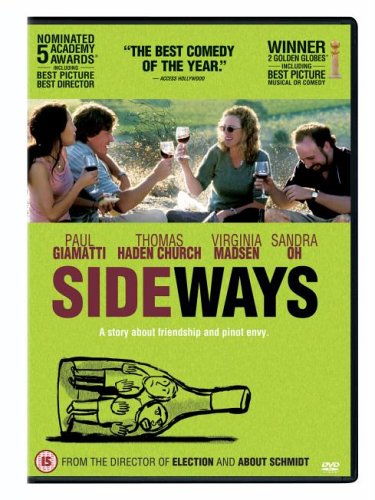
That’s a bit of a preamble to introducing the fact that no sooner do I finish the previous entry (well a couple of days later) – I’m in a megastore (HMV – Southend-on-Sea if you must know, not been to Southend for years – HMV is where Golden Disc used to be – which features in Morrissey’s Suedehead video, and may even be where I bought the 12”, I certainly got The Stone Roses and Happy Mondays records there…). And anyway, back on track – I’m in the queue buying the new Six Organs cd when I see a basket by the till full of DVDs of Sideways the movie, priced at £3.99. I still feel the same about this DVD ownership thing, but wasn’t the universe saying something to me here? Hell it was even cheaper than my imagination!

So I bought it and watched it – and what can I say – the book was better. Of course I made the fatal error of watching the film too soon after reading the book. Too much of the book was fresh in my mind, so in my head I kept thinking “is this that bit?” or “they left that bit out”, or “this is in the wrong order” rather than just settling down and enjoying the nuances of the film version. I’ve always found Virginia Madsen attractive – so that worked for me as Maya – although wasn’t Maya a brunette in the book – that’s how I imagined her?

They should have kept in the bit with the hillbilly boy who tries to scare them though, I loved that bit (maybe they filmed it, and its one of those “DVD extras – deleted scenes” that I’m too bored to watch).

Maybe I’ll watch the film again in a couple of years (hell I OWN it now) and enjoy it more.

Friday, May 26, 2006

Rubedo


Yourmindfire is one of the contributors to Rubedo a new arts and cultural site.

Influenced by the alchemical concept of rubedo, the site brings together contributors from the worlds of poetry, music, film, astrology, psychosynthesis and other therapeutic disciplines.

The site currently features "What Red is Not" a meditation on the theme of rubedo and contemporary violence by the eminent English evolutionary astrologer Mark Jones, author of the seminal work "The Nature of the Pluto in Virgo Generation".

Sunday, May 14, 2006

Tropicália


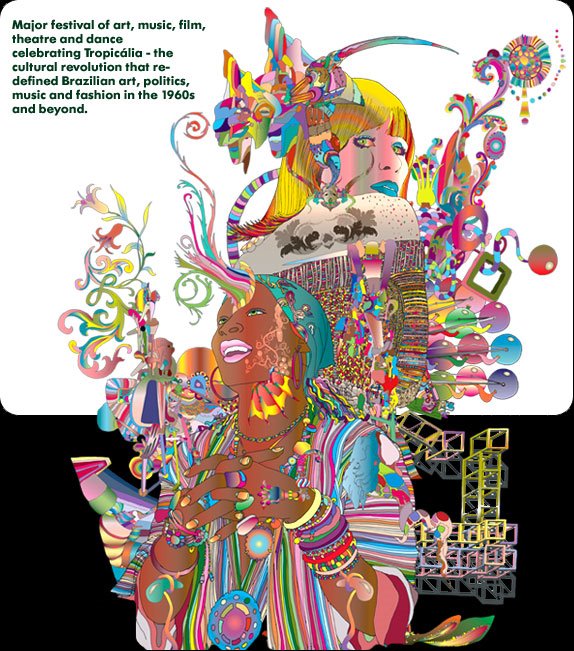
Yesterday I at last got around to the Barbican for the exhibition Tropicália: A Revolution in Brazilian Culture. It finishes May 21st so time was running out for me (and you if you fancy going).

My interest in Tropicália goes back to about 1997 when my wider explorations of psychedelia were increasingly going global and I heard the first hints that there was a Brazilian psych scene. This subsequently crystallized into 2 band names as avenues of further pursuit – The Mutants and Caetano Velaso – it would be many more months before The Mutants reverted to their original language moniker Os Mutantes, and I realised that Caetano Velaso was a man not a band. Getting any records was another issue, eventually in the World Music section of Tower Records, Piccadilly Circus I hit paydirt with the Os Mutantes album Mutantes E Seus Cometas No Pais Do Baurets (this was of course in a more primitive internet age). The cover looked promising and I was excited to get the thing home. But I thought the first track was terrible and I felt my heart sink in that way which is all too familiar to the brave record buyer who strikes out into unknown territory. After that track however it picked up and I loved it and introduced it to my friends with all the attendant thrill of a new discovery.

Keith knew a Brazilian guy called Joao and hit him up for some Brazilian tunes. Joao was pretty dismissive of Os Mutantes and various other names I’d passed through Keith – bad seventies rock was I think his interpretation of these artists, “like Phil Collins” may also have been mentioned. Still a pretty good comp tape of MPB (Musica Popular Brasileira) stuff ended up coming my way – and had to satisfy me for now. In fact that MPB tape got me through a cold winter working in the vaults of the Imperial War Museum Film and Video Archive.

As time passed by I eventually hit my other targets – the Velaso albums, Gilberto Gil, Gal Costa, more Mutantes, Tom Ze (still after that Nara Leao album mind). I came to realise the genius of Rogerio Duprat (and kudos to el/Cherry Red for re-releasing A Banda Tropicálista do Duprat). I discovered that this music was the audio wing of a Brazilian pop art movement, Tropicália – WOW I thought, how groovy! Especially when I discovered it connected up with revolutionary politics, youth movements, artists in London exile etc. etc.

So, when I found out that the Barbican was going to host an exhibition of this stuff I was thrilled. But, BOY – what a let down! For a start there really wasn’t that much to see – the gallery felt kind of empty. And what was there just didn’t seem to amount to much. It was largely ‘conceptual art’ – which I actually don’t have a problem with (all art is conceptual art, the idea that pretty pictures are good art is a concept – anyway I digress) but I think that conceptual art only really works when in presented in an engaging context. I tend to think of conceptual art like Magick, it’s about altering reality through an alteration in consciousness. For this to function requires, I believe (and to borrow from Tim Leary), an appropriate attention to ‘set and setting’. Without that the spell won’t work, things wont change and everyone goes home disappointed.

I mean the first element of this you face as a problem in the gallery context is the admission charge. Before you’ve experienced a thing, a powerful message is being placed in your mind – you are moving into a space where access is determined by the action of a financial transaction. Therefore it is limited to those who can afford it and choose to use their cash in this way. An expectation of return on one’s investment is fostered, a ‘show me’ attitude – we are placed passively as audience. We choose to use our cash in this way because wee are cultured people, we will now spend a period of time in the gallery commensurate with our expenditure (oh, 8 quid by the way, best part of a tenner in other words. Each). Now all this blathering is just to indicate that immediately I don’t think that we’re being presented with the best ‘set and setting’ for our experience on the other side of the admissions desk. I’ve always buzzed much more off gallery spaces like the Whitechapel (1) or Serpentine where you can wander freely straight into the temple.

I know that there are costs associated with doing anything that someone has to pay – but given that, shouldn’t we incorporate the terms of entry into the artwork itself – be open about the process already occurring. Perhaps entry should be afforded in Brazilian Reais only, with a bureau de change located elsewhere in the building – or entry could only be afforded by singing E Proibido Proibir as one passes over payment – or entry could require placing 4 £2 coins into a Tropicálismo slot machine/one art bandit (Oticica’s phrase “Be an outlaw, be a hero” springs to mind) and everyone wins and receives their entry ticket – or… Well you get the general idea.

Putting aside the whole paying for entry issue (and I did anyway, I just wandered in and no one stopped me), the whole set and setting thing inside wasn’t right either. There was no Magick, none of that pagan energy this kind of art demands – instead it’s just your bog standard white cube approach, like some square modernist chapel or summat. Some of the art was ‘interactive’ - in a wonderfully perverse set up – the ‘original art’ was in cases protected from us, while reproductions illustrating the concept were available to handle and engage with. These concepts appeared to have artefacts chaining them to the past, the weight of a former moment preventing them from being free, from truly entering the now – failed invocations.

The best stuff was: the album covers (and why wasn’t there more Rogério Duarte in the exhibition?); the video of Tropicália musicians in their prime (although the projected stuff looked like second generation vhs taped off-air and the sound was shit – didn’t anyone think that being able to hear the music might be important? – and why wasn’t the whole gallery filled with the pounding sounds of Tropicália?); and the women’s dresses, but there was only about six of them.

So buy the albums, listen to the music and dream up your own sixties pop art vision of Sao Paulo and Rio – it isn’t here. I looked.


(1) I’m aware that this exhibition is largely a reconstruction of Hélio Oticica’s 1967 exhibition at the Whitechapel – but I can’t really comment on that – different ‘set & setting’ – different experience.

Sunday, April 30, 2006

The People's Music

Just finished Ian MacDonald’s book The People’s Music, a series of articles/essays/chapters? on popular music – focussing on that of the sixties and seventies, largely through discrete discussions of individual artists and groups. This focus and discretion, however, is really a launch pad for a wider commentary on popular music in general and by extension popular culture in general and the contemporary mindset.

Sadly I wasn’t paying enough attention to MacDonald’s writing before his death in 2003 to have picked up on his name as one to follow in the music press. And this despite having read and greatly enjoyed his earlier book Revolution in the Head; The Beatles Records and the Sixties. This book then has done a great service in compiling some of his best work from magazines such as Arena, Mojo and Uncut and giving it more exposure. MacDonald’s deep appreciation of music and its place in culture is everywhere evident and his astute reading of some of the most written about pop artists manages to provide many new and strikingly precise analyses. His work on The Beatles is, as ever, right on the money – and his commentary on Dylan has so much truth in it you want to throw away most else written about the man.

The stand out work has to be the last two chapters though. The penultimate piece - “The People’s Music” – is an attempt to comprehend the period specificity of great pop music and a challenging defence of the argument that it has pretty much all been downhill for the last thirty years or so. The final chapter is the real killer – “Exiled from Heaven: The Unheard Message of Nick Drake”, a millenarian stand for difference, poetic consciousness and Magic. A call for the re-enchantment of everyday life.

That MacDonald’s own suicide shortly after the book’s publication might be considered prima facie evidence in the case for disabusing oneself of his conclusions regarding Drake and the world as he presents it – is an awful irony, as this exactly parallels the readings of Drake’s work that MacDonald challenges in this piece.

I suggest that you read the whole book, here’s how it ends:

“Nick Drake’s work reminds us that life is a predicament and that the world is an insoluble mystery. It can tell us that a ‘magical’, contemplative way of seeing can keep us aware of this, preventing us from destroying the world through the arrogant assumption that we know what it is. We do not. We’re all exiled from heaven, though some of us don’t realise it. But when magic reveals heaven to us in a wild flower, we remember. And then we hear the chime.”